

27 Sep LLMs (Large Language Models) vs. Traditional Machine Learning: What’s the Difference?
Traditional Machine Learning
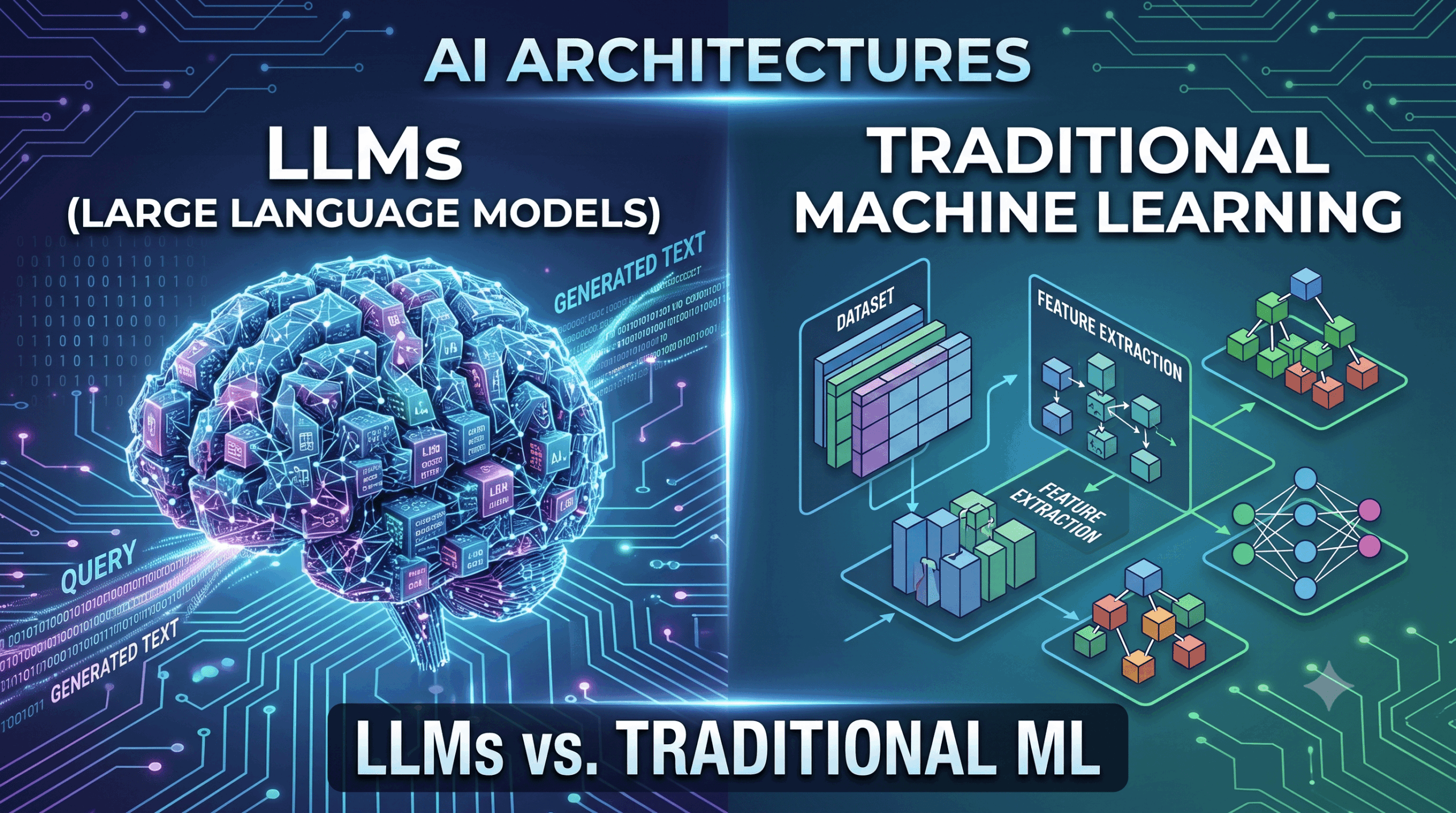
Traditional Machine Learning focuses on algorithmic statistical models such as linear regression, decision trees, random forests, and support vector machines that learn patterns from structured tabular datasets. These systems rely on human domain experts to perform explicit feature engineering and clean input data prior to model training. They remain efficient, explainable, and cost-effective solutions for tasks like fraud detection, churn prediction, and numeric forecasting.
- Focus: Task-specific mathematical algorithms (such as Random Forests, Support Vector Machines, Linear Regression, and XGBoost) designed to identify patterns, classify data, make numerical predictions, or cluster structured information.
- Difference from LLMs: Traditional Machine Learning relies heavily on structured tabular data and manual feature engineering, requiring developers to pre-process inputs explicitly. These models are deterministic, task-specific, and narrow; a model trained to detect credit card fraud cannot perform text summarization or answer customer support questions without being built and trained from scratch on entirely new data. Furthermore, traditional ML models run efficiently on modest compute resources (often single-core CPUs or basic GPUs) and offer higher interpretability and lower execution latency.
Large Language Models (LLMs)
Large Language Models are deep neural network systems based on Transformer architectures, trained on massive text datasets to process human language tasks. They rely on billions of parameters to generate contextually relevant text, translate languages, write code, and answer open-ended questions. LLMs rely on massive compute resources for training and leverage zero-shot or few-shot learning to solve varied tasks without requiring retraining for every application.
- Focus: Massive, deep learning neural network architectures (specifically Transformer models with billions or trillions of parameters) trained on unstructured multimodal and natural language data to understand context, generate human-like text, write code, and solve open-ended problems.
- Difference from Traditional Machine Learning: LLMs are general-purpose and adaptable through natural language prompting, possessing zero-shot and few-shot learning capabilities across diverse domains without requiring model re-architecting. Rather than evaluating explicit tabular features, LLMs learn representations using self-supervised learning on massive text corpora. However, LLMs require specialized AI hardware (like GPUs/TPUs), incur higher cost per inference, process probabilistic outputs that introduce the risk of hallucinations, and function as complex “black boxes” that are harder to interpret than traditional statistical algorithms.
Frequently Asked Questions (FAQs)
Q1: Can an LLM replace traditional Machine Learning for tabular data analytics and forecasting? No. While LLMs excel at processing text, speech, and code, traditional Machine Learning algorithms (like Gradient Boosted Trees or XGBoost) remain vastly superior for tabular data, numerical regression, time-series forecasting, and precise statistical classification. Traditional ML models perform these tasks faster, at a fraction of the cost, with higher accuracy and lower risk of false signals.
Q2: How do data requirements differ between traditional Machine Learning and LLMs? Traditional ML relies heavily on task-specific, curated, and labeled datasets (supervised learning). In contrast, base LLMs are pre-trained on massive, unlabelled datasets containing hundreds of billions of words from books, articles, and websites via self-supervised learning. For specific business tasks, an LLM can then be adapted using minimal task-specific data via prompt engineering or fine-tuning.
Q3: Which architecture should I choose for my business application?
-
Choose Traditional Machine Learning when working with structured numerical or tabular data (e.g., credit scoring, price prediction, inventory forecasting, anomaly detection), when strict mathematical interpretability is required, or when running on constrained compute infrastructure.
-
Choose LLMs when building applications around natural language, unstructured text, creative generation, open-ended conversational agents, code synthesis, or multi-domain reasoning tasks.
If you liked the tutorial, spread the word and share the link and our website, Studyopedia, with others.
For Videos, Join Our YouTube Channel: Join Now
Read More:

No Comments