

27 Sep Proof of Work (PoW) vs. Proof of Stake (PoS): What’s the Difference?
Proof of Work (PoW)
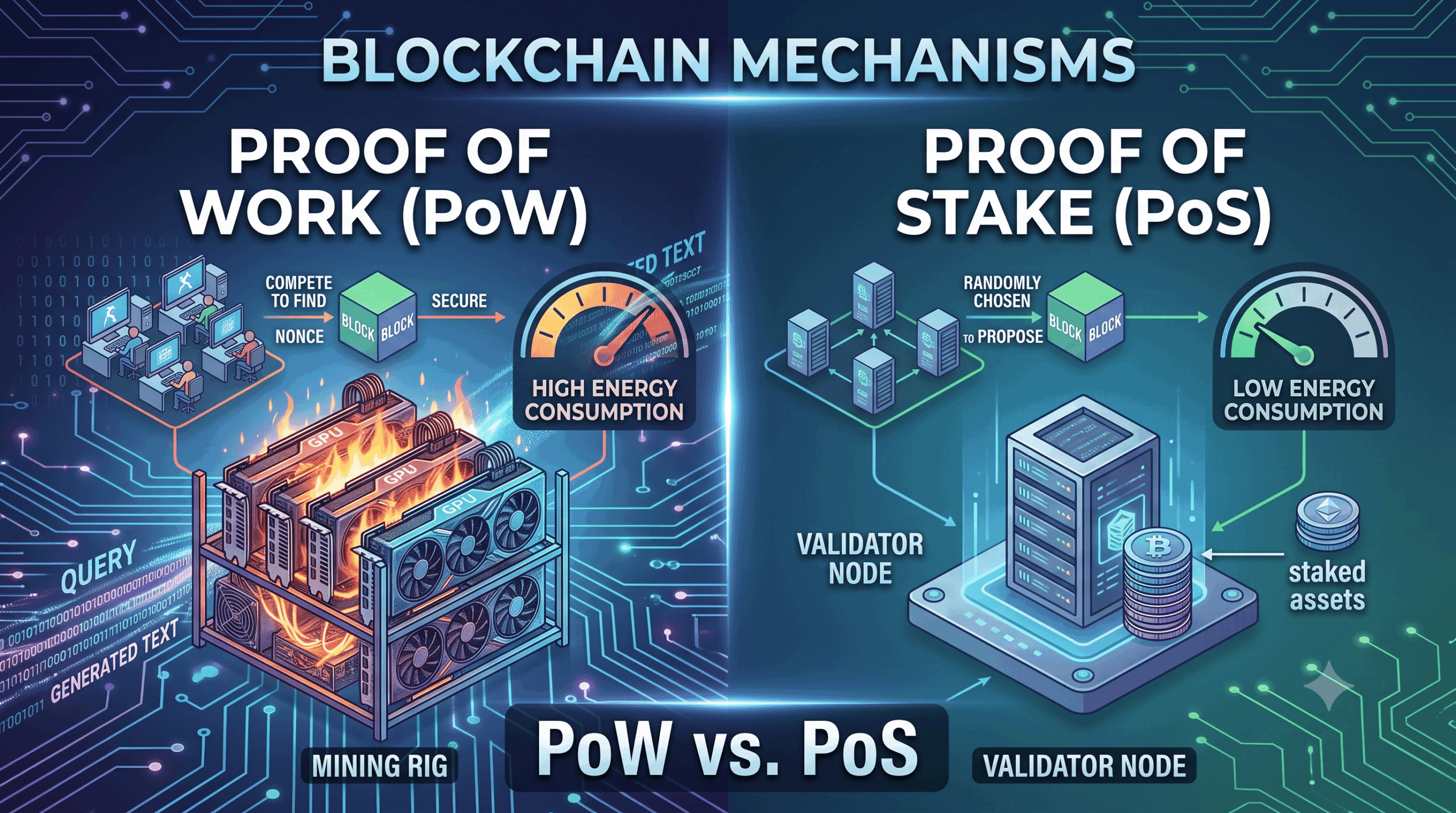
Proof of Work is a cryptographic consensus mechanism used in blockchain networks, where participating nodes (miners) compete to solve mathematical puzzles to validate pending transactions and propose new blocks. This process requires significant computational hardware and electrical energy, creating a high financial barrier that deters malicious network attacks. While highly secure and decentralized, PoW networks face scalability challenges and lower transaction speeds.
- Focus: A decentralized consensus mechanism where network nodes (miners) compete to solve complex cryptographic puzzles to validate transactions and add new blocks to the blockchain.
- Difference from Proof of Stake: Proof of Work links network security directly to real-world computational power and physical energy consumption. Miners must invest heavily in high-performance hardware (ASICs/GPUs) and expend substantial electricity to participate. If a miner attempts to validate fraudulent transactions, their economic penalty is the real-world cost of spent electricity and wasted compute time. This model prioritizes time-tested security and battle-tested immutability, but scales poorly and carries a significant environmental footprint.
Proof of Stake (PoS)
Proof of Stake is an energy-efficient blockchain consensus mechanism where network validators are selected to propose and verify blocks based on the quantity of native cryptocurrency tokens they “stake” as collateral. If a validator attempts to approve fraudulent ledger transactions, the network penalizes them by destroying a portion of their staked assets. PoS eliminates the need for mining hardware, significantly reducing operational energy consumption while enabling higher transaction throughput.
- Focus: A consensus mechanism where network participants (validators) lock up a required amount of the blockchain’s native cryptocurrency as collateral (“stake”) for the right to validate transactions and propose new blocks.
- Difference from Proof of Work: Proof of Stake replaces hardware-intensive cryptographic mining with financial collateral. Instead of spending electricity to solve puzzles, validators are chosen deterministically (often weighted by the size of their stake) to propose and attest to blocks. If a validator attempts to validate malicious or double-spent transactions, their staked funds are permanently destroyed through a mechanism known as slashing. This reduces network energy consumption by over 99%, enables higher transaction throughput, and lowers the barrier to entry for securing the network without requiring specialized industrial hardware.
Frequently Asked Questions (FAQs)
Q1: Is Proof of Stake less secure than Proof of Work? Not inherently, but they rely on different security models. PoW is secured by physical resources (computational energy), making an attack require controlling more than 50% of global mining hardware. PoS is secured by economic value (financial capital), making an attack require buying and staking over 50% of the total circulating supply—an action that would drastically drive up the asset’s price and render the attacker’s own staked holdings worthless if the network penalizes them.
Q2: How does the environmental impact compare between PoW and PoS? Proof of Stake consumes roughly 99.9% less energy than Proof of Work. Because PoS eliminates the need for millions of high-powered mining rigs competing simultaneously, nodes run on standard, low-power server infrastructure rather than specialized data centers.
Q3: Can a blockchain transition from Proof of Work to Proof of Stake? Yes. The most prominent example is Ethereum, which successfully transitioned from PoW to PoS in September 2022 during an upgrade known as “The Merge.” The transition eliminated Ethereum’s energy-intensive mining requirements while maintaining its underlying transaction history and smart contract state.
If you liked the tutorial, spread the word and share the link and our website, Studyopedia, with others.
For Videos, Join Our YouTube Channel: Join Now
Read More:

No Comments