

19 Sep Roadmap to become a Machine Learning Engineer
Machine Learning Engineers bridge the gap between theoretical data science and robust software engineering. While data scientists often focus on analyzing data and building predictive prototypes, machine learning engineers specialize in designing, building, deploying, and maintaining scalable production machine learning systems that operate continuously in complex software ecosystems.
This comprehensive roadmap presents a step-by-step guide to mastering machine learning engineering, taking you from software engineering fundamentals and math principles to production deep learning, MLOps, system architecture, and LLM infrastructure.
Visual Skill Roadmap and Flowchart
Below is a visual step-by-step path outlining the progression required to become a professional Machine Learning Engineer.
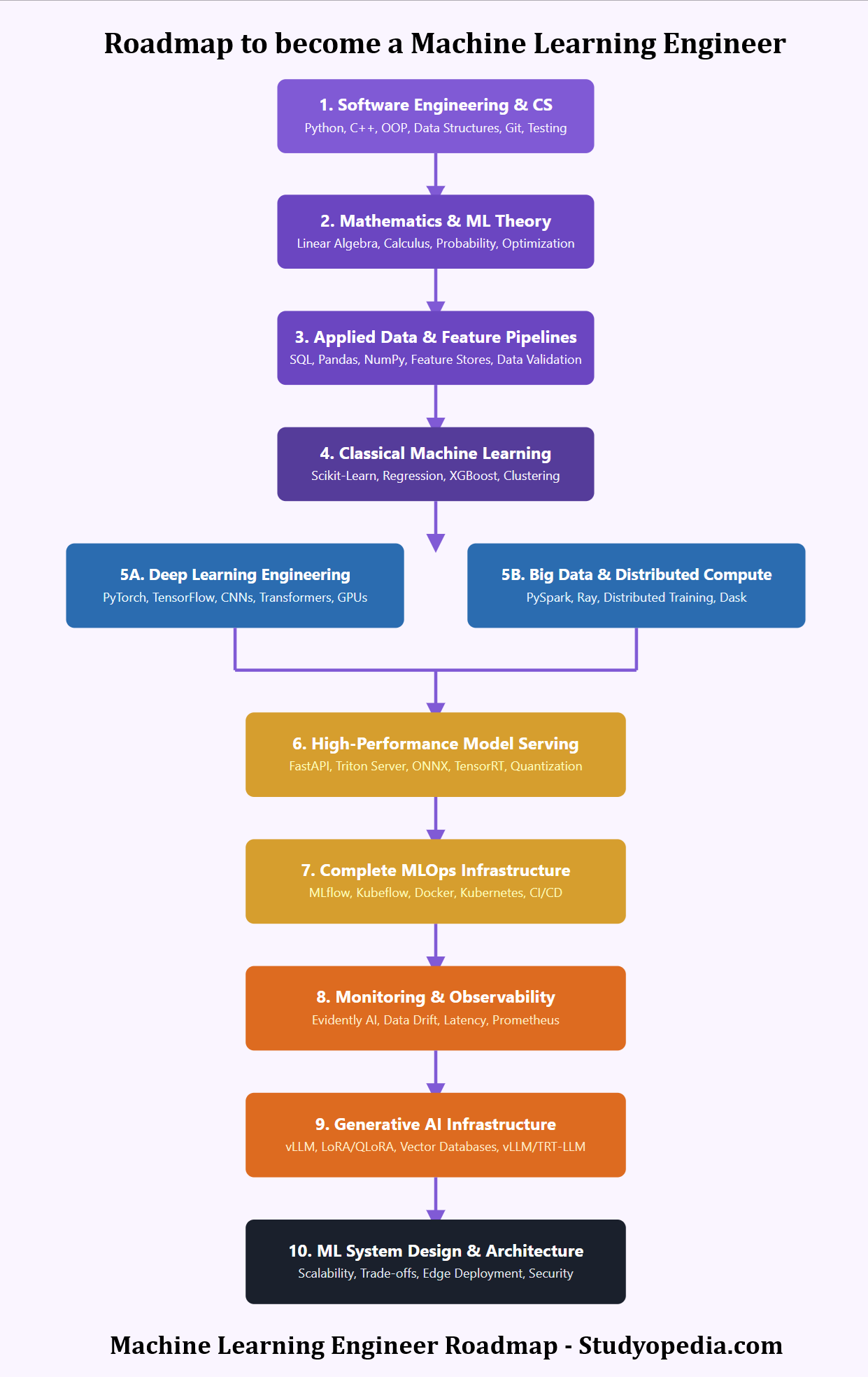
Step-by-Step Machine Learning Engineer Roadmap
1. Software Engineering and Computer Science Foundations
Unlike theoretical researchers, ML engineers write production code that runs in high throughput, low latency environments. Strong software fundamentals are non negotiable.
- Production Programming: Advanced Python proficiency emphasizing OOP, design patterns, type hinting, asynchronous execution, and memory management. Basic exposure to C++ or Rust for performance critical execution.
- Data Structures and Algorithms: Arrays, hash maps, trees, graph algorithms, big O time and space complexity optimization.
- Software Engineering Best Practices: Writing modular code, unit testing using PyTest, integration testing, code linting, and Git collaboration workflows.
2. Mathematics and Core Machine Learning Theory
A deep understanding of the underlying mathematics is essential for debugging failing models, optimizing loss functions, and modifying algorithms.
- Linear Algebra: Matrix operations, vector spaces, dot products, matrix factorization, and matrix multiplication mechanics.
- Multivariable Calculus: Partial derivatives, gradients, vector calculus, and chain rule optimization used in backpropagation.
- Probability and Statistics: Probability distributions, maximum likelihood estimation (MLE), Bayes theorem, expected value, and hypothesis evaluation.
- Optimization Theory: Convex optimization, stochastic gradient descent (SGD), Adam, and learning rate scheduling algorithms.
3. Data Engineering and Feature Pipelines
High quality machine learning applications depend entirely on steady, validated streams of clean data.
- Relational & Non-Relational Storage: Advanced SQL queries for fetching training features, and working with NoSQL database layers.
- Data Processing Libraries: Vectorized matrix processing using NumPy, structured dataset transformations using Pandas or Polars.
- Feature Stores: Managing centralized training and serving features using platforms like Feast or Hopsworks to prevent online-offline feature leakage.
4. Classical Machine Learning Models
Mastering standard statistical models and algorithms before advancing to complex neural networks.
- Supervised Learning: Linear and Logistic Regression, Decision Trees, Support Vector Machines (SVM), and Naive Bayes classifiers.
- Ensemble Frameworks: Random Forests, Gradient Boosting Trees using XGBoost, LightGBM, and CatBoost.
- Unsupervised Learning: Clustering algorithms including K-Means, DBSCAN, and Dimensionality Reduction methods like PCA and t-SNE.
Key Insight for Machine Learning Engineers
Model training is only a small fraction of a real world ML product. The vast majority of engineering effort involves data validation, pipeline orchestration, model compression, low latency serving infrastructure, and real time monitoring.
5. Deep Learning Frameworks and Distributed Computing
Building and scaling complex neural network architectures across multi GPU compute clusters.
- Frameworks: Deep proficiency in PyTorch or TensorFlow for constructing custom layers, neural networks, and training loops.
- Architectures: Convolutional Neural Networks (CNNs) for vision tasks, Recurrent Neural Networks (RNNs) for sequential tasks, and Transformer architectures for natural language processing.
- Distributed Training: Scaling multi node multi GPU training using PyTorch Distributed Data Parallel (DDP), DeepSpeed, or Ray.
6. High Performance Model Inference and Optimization
Deploying models to production requires minimizing latency and memory footprints without sacrificing predictive performance.
- Model Optimization: Model quantization (INT8/FP16 precision), pruning, knowledge distillation, and layer fusion.
- Compilation Libraries: Exporting computational graphs using ONNX, TensorRT, or OpenVINO to optimize hardware execution.
- High Throughput Servers: Serving predictions with specialized low latency inferencing servers like NVIDIA Triton Inference Server, vLLM, or TorchServe.
7. MLOps Infrastructure and CI/CD Automation
Automating the full lifecycle of machine learning systems from automated training to continuous deployment.
- Experiment Tracking & Model Registry: Tracking training parameters, artifacts, metrics, and lineage using MLflow, Weights & Biases, or Neptune.
- Containerization: Packaging prediction services into isolated Docker images and managing microservice orchestration using Kubernetes.
- Workflow Orchestration: Running automated retraining workflows using Kubeflow Pipelines, Apache Airflow, or Argo Workflows.
- ML CI/CD: Implementing automated model testing and integration pipelines using GitHub Actions and CVC (Continuous Machine Learning).
8. Monitoring, Observability, and Maintenance
Ensuring models maintain high performance in dynamic production environments where real world data constantly changes.
- Drift Detection: Tracking data drift, concept drift, and covary shift using tools like Evidently AI or Whylogs.
- Operational Metrics: Tracking service latency, throughput, GPU/CPU hardware utilization, and memory usage using Prometheus and Grafana.
- Deployment Strategies: Executing safe updates via Shadow Deployments, Canary Releases, and A/B testing infrastructure.
9. Generative AI Infrastructure and LLM Engineering
Building production systems powered by foundation models, multi modal models, and generative architectures.
- Parameter-Efficient Fine-Tuning (PEFT): Adapting large language models using LoRA, QLoRA, and prefix tuning strategies.
- Vector Infrastructure: Storing, indexing, and executing similarity searches across high dimensional vector embeddings using databases like Pinecone, Milvus, or Qdrant.
- Inference Acceleration: Serving LLM endpoints efficiently using vLLM, TensorRT-LLM, continuous batching, and paged attention strategies.
10. Machine Learning System Design and Architecture
Integrating all components into cohesive, resilient end-to-end architectures tailored to business requirements.
- System Trade-offs: Balancing offline batch predictions against real time low latency online serving.
- Edge AI Deployment: Deploying lightweight models directly to mobile devices or embedded IoT systems using TensorFlow Lite or ONNX Runtime.
- Governance & Security: Securing endpoints, protecting training data privacy, preventing adversarial prompt injections, and maintaining audit logs.
Conclusion and Next Steps
Becoming a successful Machine Learning Engineer requires building dual expertise in data science theory and software engineering scalability. Begin by strengthening Python software practices, object-oriented design, and foundational mathematical principles. Next, progress through classical machine learning, PyTorch deep learning, low-latency API serving, and end-to-end MLOps automation workflows.
If you liked the tutorial, spread the word and share the link and our website, Studyopedia, with others.
For Videos, Join Our YouTube Channel: Join Now
Recommended Posts

No Comments