

19 Sep Roadmap to become a Cloud Engineer
As modern organizations move away from traditional on-premise hardware, cloud computing has become the backbone of modern digital infrastructure. A Cloud Engineer designs, deploys, manages, and scales cloud systems to ensure high availability, security, and cost efficiency across global environments.
This comprehensive guide details the essential skills, tools, and strategic steps required to build a successful career as a Cloud Engineer, moving from core networking concepts to advanced multi-cloud architecture and site reliability practices.
Visual Skill Roadmap and Flowchart
Below is a visual step-by-step path outlining the progression required to master cloud engineering.
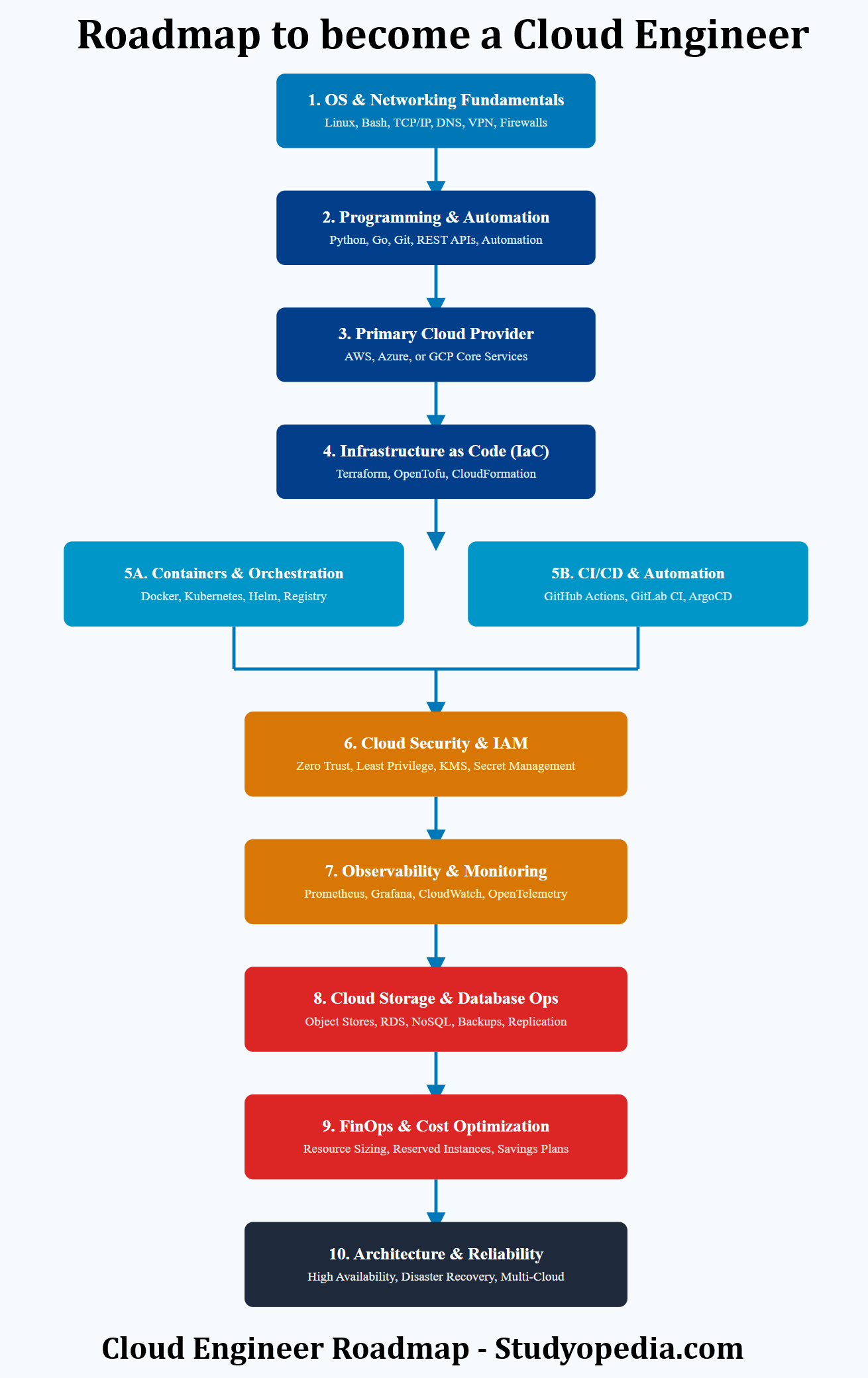
Step-by-Step Cloud Engineer Roadmap
1. Operating System and Networking Foundations
Cloud systems run primarily on virtualized Linux instances. Mastering system administration and networking protocols provides the base for all cloud infrastructure work.
- Linux Administration: Shell navigation, permission management, process monitoring, systemd service configurations, and storage management.
- Networking Essentials: Understanding the OSI model, TCP/IP stack, CIDR blocks, subnetting, public and private routing tables.
- Core Protocols and Tools: Domain Name System (DNS) configurations, HTTP/HTTPS mechanisms, SSH key management, VPNs, and firewall rules.
2. Scripting, Version Control, and Automation
Manual configurations lead to human error and scaling bottlenecks. Cloud Engineers use code to automate system administration tasks.
- Programming Languages: Writing utility scripts using Python or Go for infrastructure management and API interactions.
- Shell Scripting: Writing Bash scripts to automate routine tasks and configure system environments.
- Version Control: Managing infrastructure code updates using Git branch strategies, pull requests, and remote repositories.
3. Primary Cloud Platform Mastery
Focus on mastering one major cloud service provider before branching out into multi-cloud architectures. Choose Amazon Web Services (AWS), Microsoft Azure, or Google Cloud Platform (GCP).
- Compute Services: Virtual machines (AWS EC2, Azure VMs, GCP Compute Engine) and auto-scaling groups.
- Virtual Private Clouds: Isolated network design, subnets, NAT gateways, and peering connections.
- Identity Management: Managing platform users, service accounts, roles, and policy permissions.
- Serverless Compute: Deploying event-driven functions (AWS Lambda, Azure Functions, GCP Cloud Functions).
4. Infrastructure as Code (IaC)
Infrastructure as Code lets teams define, provision, and update cloud resources deterministically with declarative configuration files.
- Declarative IaC Tools: Writing modular infrastructure definitions using HashiCorp Terraform or OpenTofu.
- Cloud-Native Tools: Understanding platform-specific options like AWS CloudFormation, Azure ARM/Bicep, or GCP Deployment Manager.
- State Management: Managing remote state locks, backend storage, drift detection, and automated terraform plans.
Key Insight for Cloud Engineers
Avoid building cloud infrastructure manually in the cloud console interface. Treat your infrastructure resources as code by storing configurations in version control and deploying updates through continuous integration pipelines.
5. Containerization and Container Orchestration
Containers package application code alongside dependencies, ensuring seamless execution across local development and cloud production servers.
- Docker Fundamentals: Writing Dockerfiles, creating lightweight base images, multi-stage builds, and running container runtimes.
- Kubernetes Orchestration: Managing cluster resources such as Deployments, Pods, Services, Ingress Controllers, and ConfigMaps.
- Managed Cloud Kubernetes: Deploying and operating managed cluster services like AWS EKS, Azure AKS, or GCP GKE.
6. Continuous Integration and Delivery (CI/CD)
Automated software release pipelines ensure fast, safe, and reliable code deployments directly to target cloud environments.
- Pipeline Creation: Writing automated workflows using GitHub Actions, GitLab CI, or Jenkins.
- Deployment Strategies: Implementing rolling updates, blue-green deployments, and canary releases to minimize downtime.
- GitOps Practices: Utilizing GitOps tools like ArgoCD or Flux to keep real cluster states synchronized with Git source code repositories.
7. Cloud Security, IAM, and Compliance
Security must be integrated into every infrastructure layer rather than treated as an afterthought.
- Principle of Least Privilege: Granting users and services only the minimum permissions required to execute tasks.
- Data Protection: Encrypting sensitive data at rest and in transit using Key Management Services (KMS) and SSL/TLS certificates.
- Secrets Management: Storing environment variables and credentials securely using HashiCorp Vault or Cloud Secret Managers.
8. Observability, Logging, and Monitoring
To maintain high availability, Cloud Engineers need constant visibility into system health, performance metrics, and application logs.
- Metrics and Visualizations: Collecting operational metrics with Prometheus and visualizing system performance using Grafana dashboards.
- Centralized Logging: Gathering and analyzing distributed logs using tools like Elastic Stack (ELK), Fluentd, or AWS CloudWatch Logs.
- Alerting Systems: Configuring actionable thresholds to notify engineering teams before outages impact end users.
9. Cloud Storage, Databases, and FinOps
Managing operational data efficiently while keeping cloud spending under control is essential for enterprise-scale applications.
- Cloud Storage Solutions: Selecting object storage (S3), block storage (EBS), or network file systems (EFS) based on application workloads.
- Database Operations: Operating managed relational databases (AWS RDS, Cloud SQL) and NoSQL stores (DynamoDB, MongoDB) with automated backup and replication strategies.
- FinOps and Cost Optimization: Right-sizing idle instances, leveraging spot instances, utilizing reserved capacity savings, and monitoring cost allocations with detailed tag policies.
10. High Availability, Reliability, and System Design
The ultimate goal of a Cloud Engineer is to design fault-tolerant systems that withstand hardware failures, traffic spikes, and regional disruptions.
- Fault Tolerance: Distributing applications across multiple Availability Zones (AZs) and geographical cloud regions.
- Disaster Recovery (DR): Implementing backup strategies with defined Recovery Point Objectives (RPO) and Recovery Time Objectives (RTO).
- Chaos Engineering: Testing system resiliency by introducing deliberate hardware or network failures in controlled environments.
Conclusion and Next Steps
Becoming a successful Cloud Engineer requires a balance of core networking principles, platform-specific knowledge, and automation skills. Begin by building a solid foundation in Linux and networking, then pick a single primary cloud provider. As you gain experience, focus on Infrastructure as Code and automated CI/CD pipelines to build scalable, production-ready cloud environments.
If you liked the tutorial, spread the word and share the link and our website, Studyopedia, with others.
For Videos, Join Our YouTube Channel: Join Now
Recommended Posts

No Comments