

19 Sep Roadmap to become an AI ML Engineer
An AI / Machine Learning Engineer combines software engineering practices with statistical model building. While Data Scientists often focus on research and business insights, AI / ML Engineers build, train, deploy, and maintain scalable machine learning models in production software environments.
This roadmap provides a comprehensive learning path, leading from fundamental mathematical concepts to advanced deep learning architectures, production deployment, and modern Generative AI engineering.
Visual Skill Roadmap and Flowchart
Below is a visual step-by-step path outlining the progression required to master AI and Machine Learning engineering.
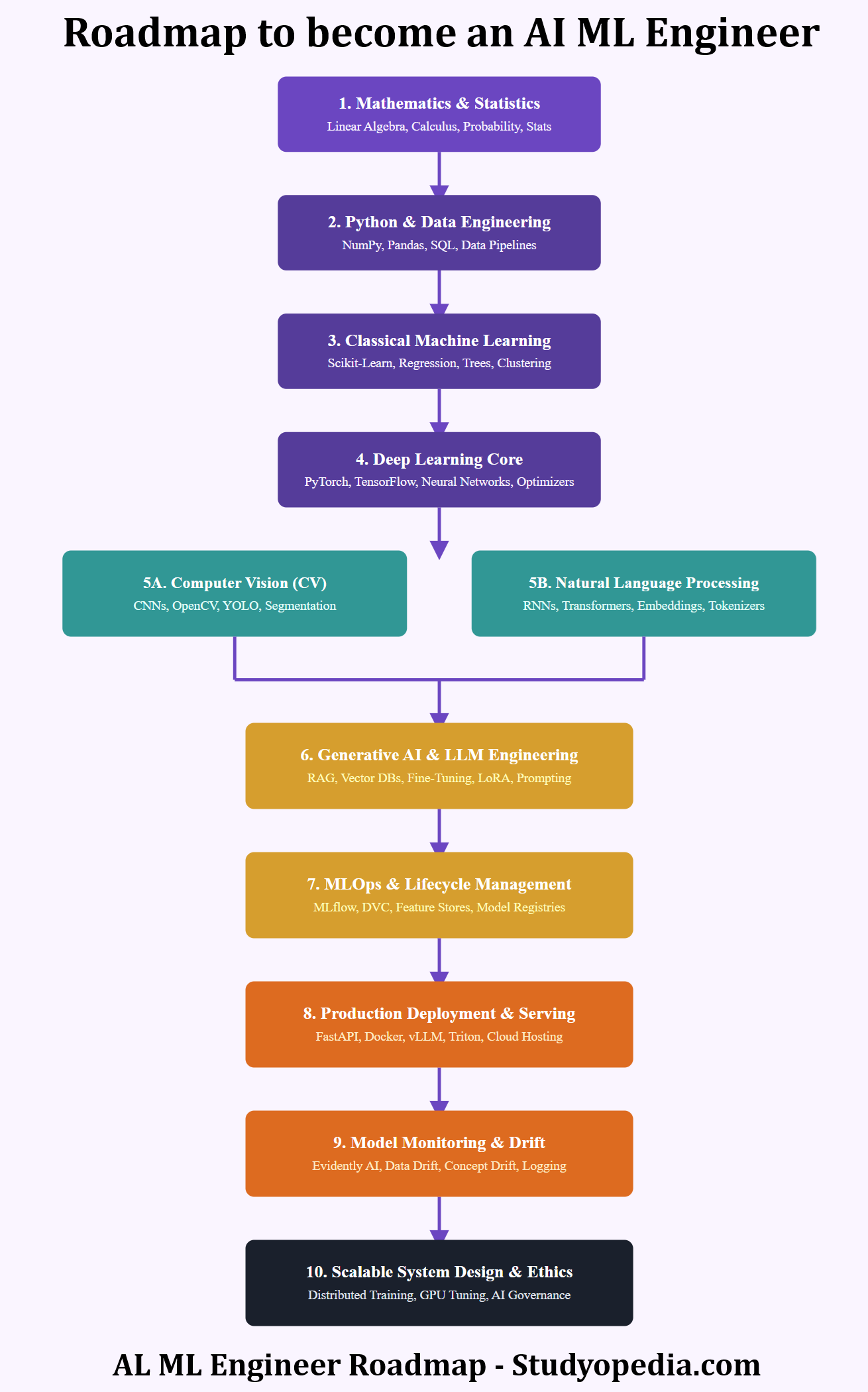
Step-by-Step AI / ML Engineer Roadmap
1. Mathematical Foundations
Machine learning models operate on numerical data through mathematical transformations. A strong foundation in underlying mathematical mechanics is critical for debugging model failure states and adjusting hyperparameters effectively.
- Linear Algebra: Vectors, matrices, matrix multiplication, eigenvalues, eigenvectors, and vector space transformations.
- Calculus: Differential calculus, partial derivatives, gradients, direction of steepest descent, and chain rule computations.
- Probability and Statistics: Bayes theorem, probability distributions, variance, standard deviation, hypothesis testing, and maximum likelihood estimation.
2. Python and Data Engineering Essentials
Data quality dictates model success. AI / ML Engineers build data extraction, transformation, and ingestion pipelines to prepare raw inputs for training algorithms.
- Python Proficiency: Data structures, object-oriented design, functional programming, vectorization mechanics, and file operations.
- Data Manipulation Libraries: Efficient numerical manipulation with NumPy, data frame operations with Pandas, and high performance data transformations with Polars.
- Database Querying: Advanced SQL operations to extract training data from relational databases and data warehouses.
3. Classical Machine Learning Algorithms
Mastering traditional machine learning algorithms provides indispensable techniques for tabular data modeling and benchmark comparison.
- Supervised Learning: Linear regression, logistic regression, support vector machines (SVM), decision trees, random forests, and gradient boosting (XGBoost, LightGBM).
- Unsupervised Learning: Clustering algorithms (K-Means, DBSCAN), anomaly detection, and dimensionality reduction techniques (PCA, t-SNE).
- Model Evaluation: Cross validation strategies, evaluation metrics ($Accuracy$, $Precision$, $Recall$, $F1-Score$, $ROC-AUC$), and bias vs variance trade-off analysis.
4. Deep Learning Core Principles
Deep Learning models process complex data formats like unstructured text, image matrices, and audio signals through multi-layered artificial neural networks.
- Neural Network Basics: Perceptrons, activation functions (ReLU, Sigmoid, GELU), forward propagation, and backpropagation mechanisms.
- Training Optimization: Loss functions, gradient descent variants (SGD, Adam, AdamW), learning rate schedules, and regularization techniques (Dropout, Weight Decay).
- Framework Mastery: Designing models natively using PyTorch (the dominant research and production framework).
Key Insight for Machine Learning Engineers
Model accuracy is only part of the equation. An AI / ML Engineer must continuously evaluate inference latency, hardware resource requirements, training costs, and memory footprints when moving models to live production environments.
5. Specialized Domains: Computer Vision & NLP
Depending on organizational focus, ML Engineers specialize in unstructured text processing, image processing, or both domains.
- Computer Vision (CV): Convolutional Neural Networks (CNNs), object detection architectures (YOLO), image segmentation, and image processing tools like OpenCV.
- Natural Language Processing (NLP): Tokenization strategies, word embeddings (Word2Vec), Recurrent Neural Networks (RNNs), and the Transformer architecture (Self-Attention mechanism).
6. Generative AI and Large Language Models (LLMs)
Modern AI applications rely heavily on pre-trained foundation models integrated into custom software workflows.
- Retrieval-Augmented Generation (RAG): Chunking strategies, embedding generation, vector indexing using Pinecone, Qdrant, or ChromaDB, and hybrid search re-ranking.
- Model Adaptation: Parameter-Efficient Fine-Tuning (PEFT) techniques including Low-Rank Adaptation (LoRA) and Quantized LoRA (QLoRA) using tools like Unsloth and Hugging Face TRL.
- Prompt Engineering and Orchestration: Constructing systematic prompts, tool calling mechanisms, and agent frameworks using LangChain or LlamaIndex.
7. Machine Learning Operations (MLOps)
MLOps introduces software engineering rigor to model development, ensuring reproducibility and artifact tracking across model versions.
- Experiment Tracking: Logging training runs, parameters, metrics, and model artifacts using MLflow or Weights & Biases.
- Data and Model Versioning: Managing data lineage and multi-gigabyte dataset versions using Data Version Control (DVC).
- Feature Stores: Implementing centralized feature repositories (Feast) to maintain consistent feature logic across training and online inference environments.
8. Model Serving, Deployment, and Infrastructure
Transforming trained model weights into accessible, sub-second API endpoints requires specialized inference serving infrastructure.
- API Creation: Wrapping model calls inside lightweight FastAPI web services or gRPC services.
- Optimized Inference Engines: Deploying language models with high throughput runtimes like vLLM, TensorRT-LLM, or Triton Inference Server.
- Containerization: Packaging model dependencies, CUDA libraries, and application logic into reproducible Docker container images.
9. Monitoring, Governance, and Model Drift
Models degrade over time as real world user behavior shifts. Continuous monitoring safeguards predictions against inaccuracy.
- Data Drift: Detecting statistical changes in input features using tools like Evidently AI.
- Concept Drift: Identifying when relationships between input features and target predictions degrade over time.
- AI Safety and Guardrails: Input validation, toxic content filtration, and prompt injection mitigation.
10. Distributed Systems, Scaling, and AI Ethics
Large AI systems require distributed hardware setups to handle billion parameter models efficiently across server nodes.
- Distributed Training: Parallelizing training jobs across multiple GPUs using PyTorch Distributed Data Parallel (DDP) or Fully Sharded Data Parallel (FSDP).
- Quantization and Optimization: Compressing models using $INT8$ or $INT4$ quantization, ONNX export, and pruning strategies.
- AI Governance and Ethics: Implementing algorithmic fairness checks, explainability tools (SHAP, LIME), and complying with regulatory framework standards.
Conclusion and Next Steps
Becoming an AI / ML Engineer requires balancing mathematical understanding with practical software engineering discipline. Begin by mastering Python, data manipulation libraries, and fundamental machine learning algorithms. As you progress, build projects that take raw data, train neural models, and serve inferences via production API endpoints.
If you liked the tutorial, spread the word and share the link and our website, Studyopedia, with others.
For Videos, Join Our YouTube Channel: Join Now
Recommended Posts

No Comments