

23 Sep Machine Learning Tutorial
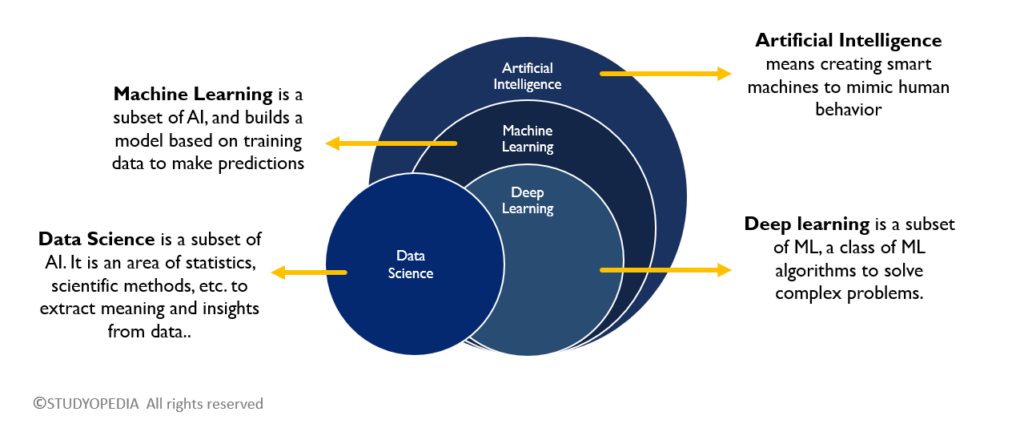
Machine Learning is a subset of Artificial Intelligence. The computer is fed with data and information. This gives these systems the ability to learn and improve from experience. This happens without explicit programming. In the figure below, you can easily understand the ecosystem of Machine Learning:
FAQs
Q1: What is Machine Learning and how does it work?
Ans: Machine Learning (ML) is a branch of Artificial Intelligence (AI) that allows computer systems to automatically learn and improve from data and experience without being explicitly programmed. Instead of traditional hand-coded rules, ML algorithms analyze historical data to detect patterns, make decisions, and accurately predict outcomes on new data.
Q2: What are the main types of Machine Learning?
Ans: Machine Learning is broadly categorized into four primary types:
- Supervised Learning: Trains models using labeled data to perform tasks like Classification and Regression.
- Unsupervised Learning: Finds hidden patterns or groupings in unlabeled data using techniques like Clustering.
- Semi-Supervised Learning: Uses a small amount of labeled data alongside a large amount of unlabeled data for training.
- Reinforcement Learning: Uses an agent that learns optimal behaviors through trial and error using rewards and penalties.
Q3: What is the difference between Classification, Regression, and Clustering?
Ans: These represent key machine learning tasks:
- Classification: A supervised learning task that assigns data points into discrete categories (e.g., spam detection, disease diagnosis).
- Regression: A supervised learning task that predicts continuous numerical values (e.g., house price forecasting, temperature prediction).
- Clustering: An unsupervised learning task that groups similar data points based on inherent traits without predefined labels (e.g., customer segmentation).
Q4: How do you evaluate a Machine Learning model’s performance?
Ans: ML models are evaluated using quantitative performance metrics calculated on test data, often summarized using a Confusion Matrix. Common metrics include:
- Accuracy: Overall percentage of correct predictions.
- Precision: Ratio of true positive predictions to total predicted positives.
- Recall: Ratio of true positive predictions to actual positive cases in the dataset.
- F1 Score: The harmonic mean of precision and recall, ideal for imbalanced datasets.
Q5: What algorithms and core ML topics are covered in Studyopedia’s Machine Learning tutorial?
A: Studyopedia’s tutorial covers essential Machine Learning fundamentals, key terminologies (Overfitting, Underfitting, Bagging vs. Boosting, Transfer Learning), model evaluation metrics, and practical implementations of core algorithms including Decision Trees, Random Forest, K-Nearest Neighbors (KNN), Support Vector Machines (SVM), Naive Bayes, and K-Means Clustering.
Machine Learning Tutorial – Index
Machine Learning – Introduction
Machine Learning – Model
Machine Learning – Terminologies
- Inductive vs Deductive Machine Learning
- Bagging vs Boosting in Machine Learning
- Overfitting & Underfitting in Machine Learning
- Confusion Matrix in Machine Learning
- Transfer Learning in Machine Learning
Machine Learning – Types
- Types of Machine Learning.
- Supervised Machine Learning
- Unsupervised Machine Learning
- Semi-Supervised Machine Learning
- Reinforcement Machine Learning
- Supervised vs Unsupervised vs Reinforcement Machine Learning
Machine Learning – Classification
- What is Classification
- Applications of Classification
- Types of Classification
- Decision Tree
- K-Nearest Neighbors (KNN) Algorithm Tutorial
- Support Vector Machine
- Naive Bayes
- Random Forest
Machine Learning – Regression
- What is Regression
- Applications of Regression
- Types of Regression
- What is Logistic Regression
- What is Linear Regression
- Linear vs Logistic Regression
- When to choose Classification over Regression
Machine Learning – Clustering
Machine Learning – Other Algorithms
- Dimensionality Reduction Algorithms
- Gradient Boosting Algorithm and AdaBoosting Algorithm
Machine Learning – Model Evaluation
Model Evaluation Methods
Which metric is important
If you liked the tutorial, spread the word and share the link and our website Studyopedia with others.
For Videos, Join Our YouTube Channel: Join Now
Read More:
- Generative AI Tutorial
- Power BI Tutorial
- Python Tutorial
- Data Science Tutorial
- Numpy Tutorial
- Pandas Tutorial
- Matplotlib Tutorial
- MySQL Tutorial
- SQL Server Tutorial

No Comments