


19 Dec Data Science Tutorial
Data Science is the study of Data. It combines various disciplines, including statistics, scientific methods, artificial intelligence, etc. This is done to extract meaning and insights from data.
Python for Data Science – Roadmap
Data Science – Popularity
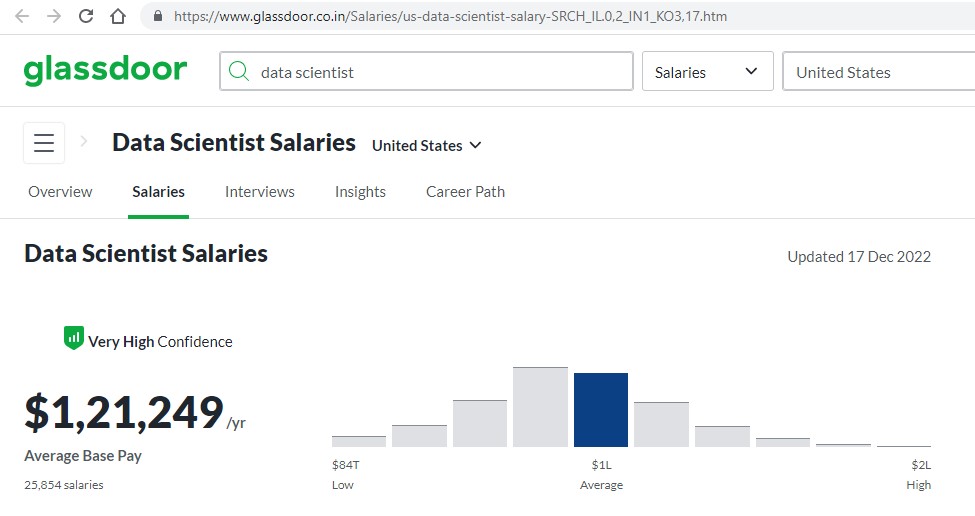
Data Science is trending these days. Data is the new oil. Learn Data Science to be a Data Scientist. According to Glassdoor, the average base salary for Data Scientists in the United States is $121,249 per year:
Viewers
The Data Science tutorial is prepared for students, engineers, and professionals. This tutorial will be useful for understanding Data Science concepts for Data Science enthusiasts. The United States Data Science Institute published a report that predicts by 2026, 11.5 million jobs will be created for data scientists.
Data Science Tutorial Index
✔️ Data Science Tutosrial
✔️ Python Tutorial
✔️ Numpy Tutorial
✔️ Pandas Tutorial
✔️ Matplotlib Tutorial
✔️ Machine Learning Tutorial
✔️ Deep Learning Tutorial
✔️ Deep Analysis Tutorial
FAQs
Q1: What is Data Science and why is it important?
A: Data Science is an interdisciplinary field that combines statistics, scientific methods, artificial intelligence (AI), and data analysis to extract meaningful insights and actionable business intelligence from structured and unstructured data. It is critical today because organizations rely on data-driven decision-making to optimize operations, predict trends, and build automated systems.
Q2: What is the difference between Data Science, Machine Learning, Artificial Intelligence, and Deep Learning?
A: While related, these concepts represent different scopes:
- Artificial Intelligence (AI): The overarching field of creating intelligent machines capable of mimicking human reasoning.
- Data Science: A broad discipline that encompasses data collection, processing, statistical analysis, and machine learning to derive business insights.
- Machine Learning (ML): A subset of AI focusing on algorithms that learn patterns from data to make predictions without explicit programming.
- Deep Learning (DL): A specialized subfield of Machine Learning that uses multi-layered neural networks to model complex relationships in unstructured data like images, speech, and text.
Q3: Which programming languages and libraries are best for Data Science?
A: Python is the primary programming language used in Data Science due to its rich ecosystem of specialized open-source libraries:
- Data Manipulation & Analysis: NumPy and Pandas.
- Data Visualization: Matplotlib, Seaborn, Tableau, and Power BI.
- Machine Learning & Deep Learning: Scikit-Learn, Keras, TensorFlow, and PyTorch.
- Generative AI & LLM Tools: LangChain, Hugging Face, and RAG frameworks.
Q4: What is the difference between Structured and Unstructured Data in Big Data?
A: Structured Data is highly organized, relational data stored in defined formats like SQL databases, Excel spreadsheets, and CSV files. Unstructured Data lacks a predefined format or structure and includes media like videos, raw text, social media posts, PDFs, and audio recordings. Data Science provides tools to extract value from both data types.
Q5: What topics and technologies are covered in Studyopedia’s Data Science tutorial?
A: Studyopedia’s Data Science tutorial covers core fundamentals including Big Data, structured vs. unstructured data, and data extraction techniques. It provides dedicated learning paths for Python, NumPy, Pandas, Matplotlib, Machine Learning, Deep Learning, Generative AI, LangChain, RAG, and data visualization tools like Tableau, Power BI, and SQL.

No Comments