

19 Sep Roadmap to become a Java Full Stack Engineer
A Java Full Stack Developer is a versatile software engineer who manages both the frontend user experience and the backend server architecture. Java remains one of the most reliable and widely adopted enterprise backend ecosystems globally, powering systems across financial institutions, e-commerce giants, and cloud platforms.
This roadmap offers a structured pathway to guide you from foundational Java concepts to advanced microservices design, modern frontend integration, and automated cloud deployments.
Visual Skill Roadmap and Flowchart
Below is a step-by-step visual representation of the learning path. Master the backend core first before connecting modern frontend frameworks and deployment infrastructure.
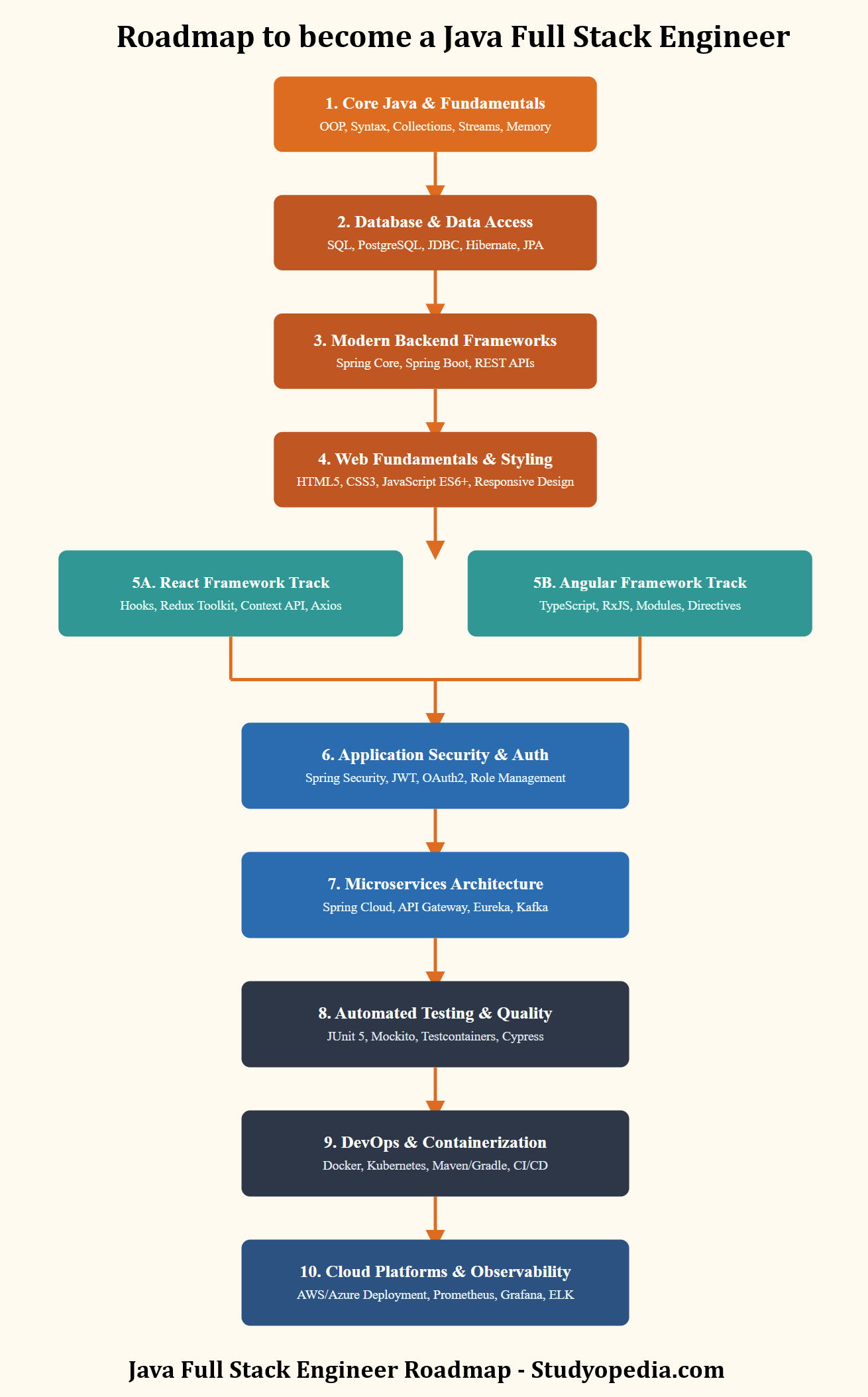
Step-by-Step Java Full Stack Roadmap
1. Core Java & Language Fundamentals
A strong backend foundation begins with mastering the Java programming language. Focus on modern Java features (Java 27) rather than legacy paradigms.
- Object-Oriented Programming (OOP): Inheritance, Polymorphism, Encapsulation, Abstraction, and SOLID principles.
- Data Structures & Collections Framework: List, Set, Map implementations, Queue, and concurrent data structures.
- Modern Java Features: Streams API, Lambdas, Optional class, Records, and Pattern Matching.
- JVM Internals: Garbage collection algorithms, Heap vs Stack memory, JVM execution mechanics.
2. Relational Databases & Persistence Layers
Most enterprise applications depend on reliable relational data stores. Understanding how Java interfaces with database management systems is vital.
- Database Engines: PostgreSQL or MySQL for relational data design and complex query optimization.
- SQL Concepts: Joins, indexing strategies, transactions (ACID properties), views, and stored procedures.
- Java Persistence: JDBC driver mechanics, Object-Relational Mapping (ORM) using Hibernate, and Java Persistence API (JPA).
3. Backend Development with Spring Boot
Spring Boot is the standard for building enterprise Java microservices and web applications.
- Spring Core: Dependency Injection (DI), Inversion of Control (IoC), and Bean Lifecycle management.
- Spring Boot API Development: Building RESTful APIs using @RestController, handling HTTP verbs, request parameters, and response entities.
- Spring Data JPA: Automated repository interfaces, custom JPQL queries, and database transaction management (@Transactional).
4. Frontend Core Technologies
To connect user interfaces with backend APIs, you need a solid understanding of browser technologies.
- Semantic HTML5: Document layout, accessible web forms, and standard accessibility patterns (ARIA).
- Modern CSS3: Flexbox layouts, CSS Grid, custom properties, and responsive design techniques.
- JavaScript (ES6+): Async/Await, Promises, Fetch API, DOM manipulation, ES Modules, and closure scope mechanics.
5. Single Page Application Frameworks
Choose one primary modern frontend library or framework to build rich client-side applications.
- Option A (React): Functional components, React Hooks (useState, useEffect, useReducer), State Management (Redux Toolkit or Context API), and routing with React Router.
- Option B (Angular): TypeScript fundamentals, RxJS observables, Angular CLI, Dependency Injection, RxJS State Management, and Routing modules.
- API Integration: Asynchronous data fetching using Axios or the native Fetch API to interface with Spring Boot backend endpoints.
Key Insight for Full Stack Engineers
Focus heavily on API boundary contracts. Understanding JSON schemas, CORS policy configurations, and asynchronous state synchronization between Java REST endpoints and client-side web frameworks is what defines a successful Full Stack Developer.
6. Security and Authentication
Protecting user data and locking down API routes is essential before moving applications into production environment stages.
- Spring Security: Security filter chains, authentication managers, and custom authorization mechanisms.
- Token-Based Authentication: JSON Web Tokens (JWT) creation, validation, and refresh token flows.
- Enterprise Protocols: OAuth2 and OpenID Connect (OIDC) integration for Single Sign-On (SSO) providers.
7. Microservices and Distributed Systems Architecture
Large enterprises split monolithic architectures into smaller, independently scalable microservices.
- Spring Cloud Ecosystem: Eureka Service Registry, API Gateways (Spring Cloud Gateway), and Resilience4j circuit breakers.
- Asynchronous Messaging: Event-driven architecture using Apache Kafka or RabbitMQ for inter-service communication.
- Caching: Distributed caching mechanisms with Redis to decrease database read operations.
8. Automated Testing & Code Quality
High-quality applications rely on robust automated test suites to prevent software regressions.
- Backend Unit Testing: Writing tests with JUnit and mocking database or external service layers with Mockito.
- Integration Testing: Using Testcontainers to spin up real database containers during build phases.
- Frontend Testing: Unit tests using Jest or React Testing Library, and end-to-end (E2E) testing with Cypress or Playwright.
9. Build Automation, Containerization, and DevOps
Modern applications are packaged inside isolated container units for reproducible deployment across cloud environments.
- Build Tools: Automation and dependency management using Maven or Gradle.
- Containerization: Packaging backend JAR files and frontend builds into Docker images using multi-stage builds.
- Orchestration Basics: Running multi-container environments using Docker Compose, followed by Kubernetes deployment fundamentals.
- Continuous Integration / Delivery: Creating pipeline scripts using GitHub Actions or Jenkins to automate build and release workflows.
10. Cloud Services and Monitoring
Once deployed, full-stack software must be actively monitored for performance bottlenecks, errors, and resource usage spikes.
- Cloud Providers: Hosting applications on Amazon Web Services (AWS) or Microsoft Azure (EC2, ECS, S3, RDS).
- Application Observability: Metric gathering with Prometheus, custom metrics visualization via Grafana, and centralized log management using the ELK Stack (Elasticsearch, Logstash, Kibana).
Conclusion and Next Steps
Mastering the Java Full Stack ecosystem takes steady effort. Begin by acquiring a solid grounding in Java OOP principles and Spring Boot. Once your backend APIs operate effectively, pair them with a modern React or Angular frontend before advancing to cloud infrastructure and containerized deployments.
If you liked the tutorial, spread the word and share the link and our website, Studyopedia, with others.
For Videos, Join Our YouTube Channel: Join Now
Recommended Posts

No Comments