

19 Sep Roadmap to become an AI Engineer
Artificial Intelligence has experienced a seismic shift. The traditional boundaries between data science, machine learning research, and software engineering have unified into a specialized, high-demand role: The AI Engineer. Unlike traditional machine learning researchers who focus primarily on training novel models from scratch, AI Engineers excel at integrating, fine-tuning, orchestrating, and deploying modern AI models into production-ready software applications.
Whether you are transitioning from software engineering, web development, or data analysis, this comprehensive roadmap outlines the exact path needed to master AI engineering—from fundamental computer science principles to advanced Large Language Model (LLM) orchestration and MLOps.
Visual Skill Roadmap & Flowchart
Below is a visual overview of the progression path. Follow the stages sequentially to build a robust foundation before tackling advanced application design.
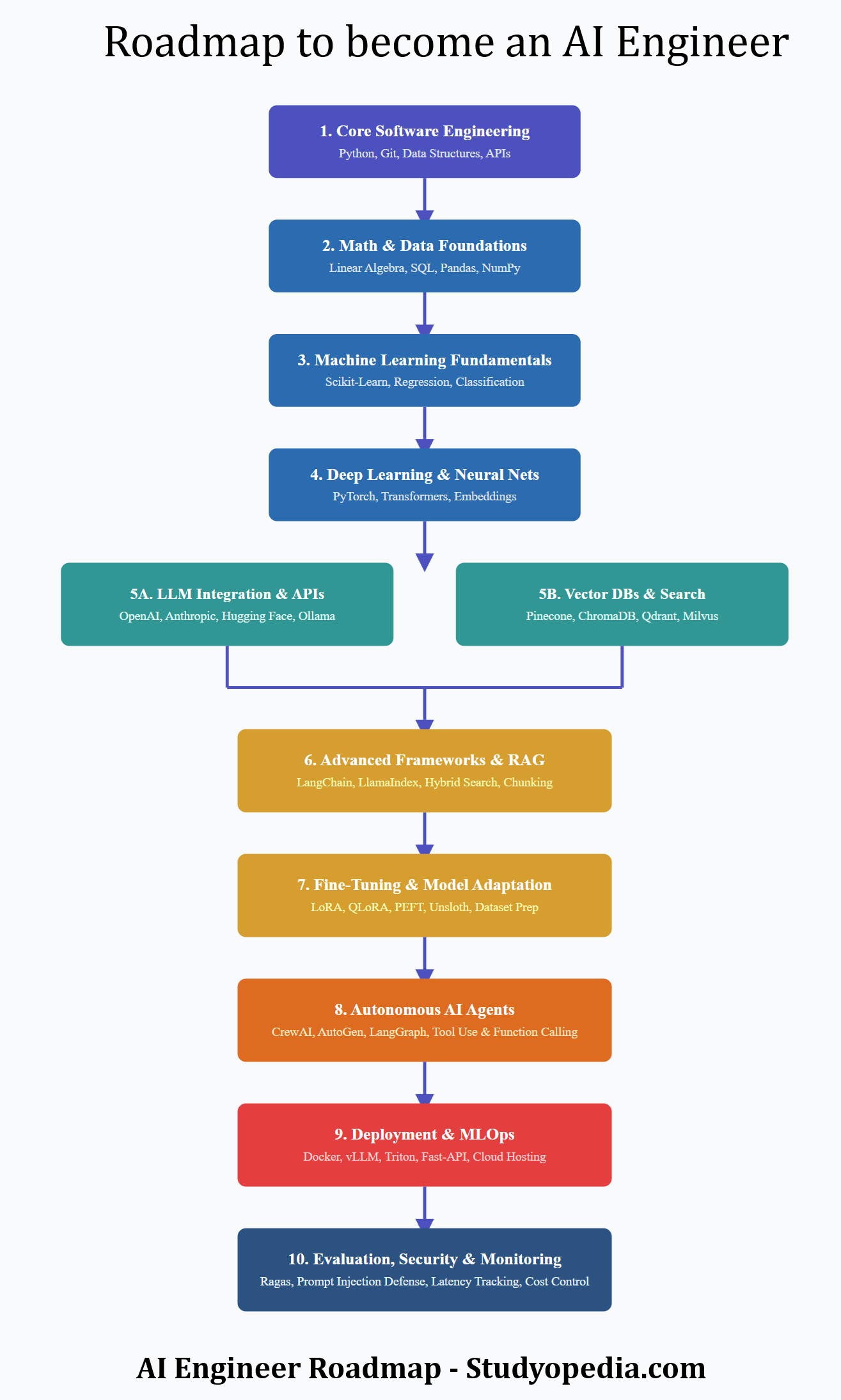
Step-by-Step AI Engineering Roadmap
1. Software Engineering Foundations
Before working with intelligence, you must master the plumbing. AI applications rely on standard engineering practices to handle network requests, data serialization, and concurrent workflows efficiently.
- Primary Programming Language: Python is non-negotiable. Learn asynchronous programming ($asyncio$), type hinting, and package management (Poetry, Conda, or UV).
- Version Control & Collaboration: Git, GitHub workflows, CI/CD basic concepts.
- API Design: Building REST and GraphQL endpoints with FastAPI or Flask to expose model features to front-end clients.
- Data Structures & Algorithms: Memory management, time complexity analysis ($O(n)$ notation), and efficient data structures.
2. Data Handling and Mathematics Primer
AI models treat text, images, and video as numerical representations. Understanding how data is transformed is necessary for debugging performance bugs.
- Essential Math: Linear Algebra (vectors, matrices, dot products), Probability and Statistics (Bayesian inference, probability distributions), and Basic Calculus (gradients and partial derivatives).
- Data Manipulation: Master
pandasfor tabular data processing,numpyfor vector operations, andpolarsfor high-performance transformations. - Database Mastery: Relational databases (PostgreSQL) and Structured Query Language (SQL) for pulling training or inference data.
3. Classical Machine Learning Core
Do not jump directly to neural networks without understanding traditional ML concepts. Many business problems are solved faster and cheaper with lightweight algorithms.
- Supervised Learning: Linear regression, logistic regression, decision trees, random forests, and gradient boosting machines (XGBoost, LightGBM).
- Unsupervised Learning: K-Means clustering, PCA (Principal Component Analysis) for dimensionality reduction.
- Key Metrics: Precision, Recall, F1-Score, ROC-AUC, and Mean Squared Error ($MSE$).
4. Deep Learning & Transformer Architectures
Deep Learning is the backbone of modern Generative AI. You must understand how neural networks pass signals and learn features.
- Frameworks: PyTorch (industry standard for AI development and production research).
- Neural Network Concepts: Backpropagation, activation functions (ReLU, GELU), loss functions, and optimizers (AdamW).
- The Transformer Architecture: Study the self-attention mechanism, multi-head attention, position embeddings, and encoder-decoder paradigms (BERT vs. GPT models).
5. LLM Integration & Vector Search
Once you understand Transformers, learn to consume foundation models programmatically and handle unstructured context through vector space embeddings.
- API Integration: Interfacing with proprietary APIs (OpenAI, Anthropic Claude) and open-source models via hosting engines (Hugging Face, Ollama, Groq).
- Embeddings: Converting text into dense mathematical vectors using embedding models (e.g., text-embedding-3-small, BGE).
- Vector Databases: Indexing and performing fast nearest-neighbor searches using databases like Pinecone, Qdrant, ChromaDB, or Weaviate.
Pro Tip for Aspiring Engineers
The difference between a developer who uses an API and an AI Engineer lies in understanding latency, retrieval optimization, cost control, and fallback strategies when a model hallucinate or fails.
6. Retrieval-Augmented Generation (RAG)
RAG connects Large Language Models to external knowledge bases without re-training the base weights. This is one of the most critical enterprise skill sets.
- Text Processing: Document loaders, semantic chunking strategies, and token handling.
- Retrieval Techniques: Dense retrieval (vectors), Sparse retrieval (BM25), and Hybrid Search combined with Re-ranking models (Cohere Rerank).
- Frameworks: LangChain and LlamaIndex for chaining operations, managing context windows, and building knowledge graphs.
7. Fine-Tuning and Model Adaptation
When prompting or RAG is insufficient for specialized domains (e.g., custom JSON output formats or domain-specific terminology), fine-tuning becomes necessary.
- Parameter-Efficient Fine-Tuning (PEFT): Techniques like LoRA (Low-Rank Adaptation) and QLoRA to fine-tune models on consumer hardware.
- Data Preparation: Instruction-tuning datasets, synthetic data generation, and cleaning pipeline creation.
- Tools: Hugging Face TRL, Unsloth, and Axolotl.
8. Autonomous Agents & Tool Usage
Agents move beyond static Q&A by giving LLMs execution capabilities through loops, tool usage, dynamic planning, and self-reflection.
- Function Calling: Teaching models to execute custom Python code, call external APIs, or run database queries.
- Agentic Frameworks: LangGraph, CrewAI, and AutoGen for building multi-agent collaborative workflows with persistence and memory.
9. MLOps, Serving & Deployment
Building an AI app locally is straightforward; serving it to thousands of concurrent users with sub-second latency requires production infra skills.
- Optimized Inference Engine Deployment: vLLM, TensorRT-LLM, TGI (Text Generation Inference), and Ollama.
- Containerization & Cloud: Docker containers, Kubernetes orchestration, and cloud deployments on AWS, GCP, or Modal.
- Streaming: Server-Sent Events (SSE) and WebSockets for real-time streaming output responses.
10. Evaluation, Safety & Governance
Modern AI applications require continuous evaluation to ensure reliability, guard against adversarial prompts, and remain compliant with regulations.
- AI Evaluation (Evals): Automated evaluation suites using frameworks like Ragas, DeepEval, and Promptfoo.
- Security: Defending against prompt injections, data leakage, and implementing guardrails (NeMo Guardrails, Llama Guard).
- Observability: Tracking token usage, tracing execution trees, and logging latency using tools like LangSmith, Phoenix, or Arize.
Conclusion & Next Steps
Becoming a proficient AI Engineer is an iterative journey. Start by solidifying your Python and API development fundamentals. Build real-world projects early—such as a domain-specific conversational document assistant or an automated Web scraping agent—and progressively apply production MLOps practices as your application scales.
If you liked the tutorial, spread the word and share the link and our website, Studyopedia, with others.
For Videos, Join Our YouTube Channel: Join Now
Recommended Posts

No Comments