

19 Sep Roadmap to become a Product Manager
Product Management sits at the intersection of business strategy, technology implementation, and user experience design. A Product Manager (PM) guides the cross-functional lifecycle of a product from initial market discovery to launch, iteration, and long-term expansion.
Whether transitioning from engineering, design, marketing, or business analysis, this roadmap outlines the essential competencies required to master modern Product Management.
Visual Skill Roadmap and Flowchart
Below is a step-by-step visual guide outlining the progression path from core strategy to product leadership.
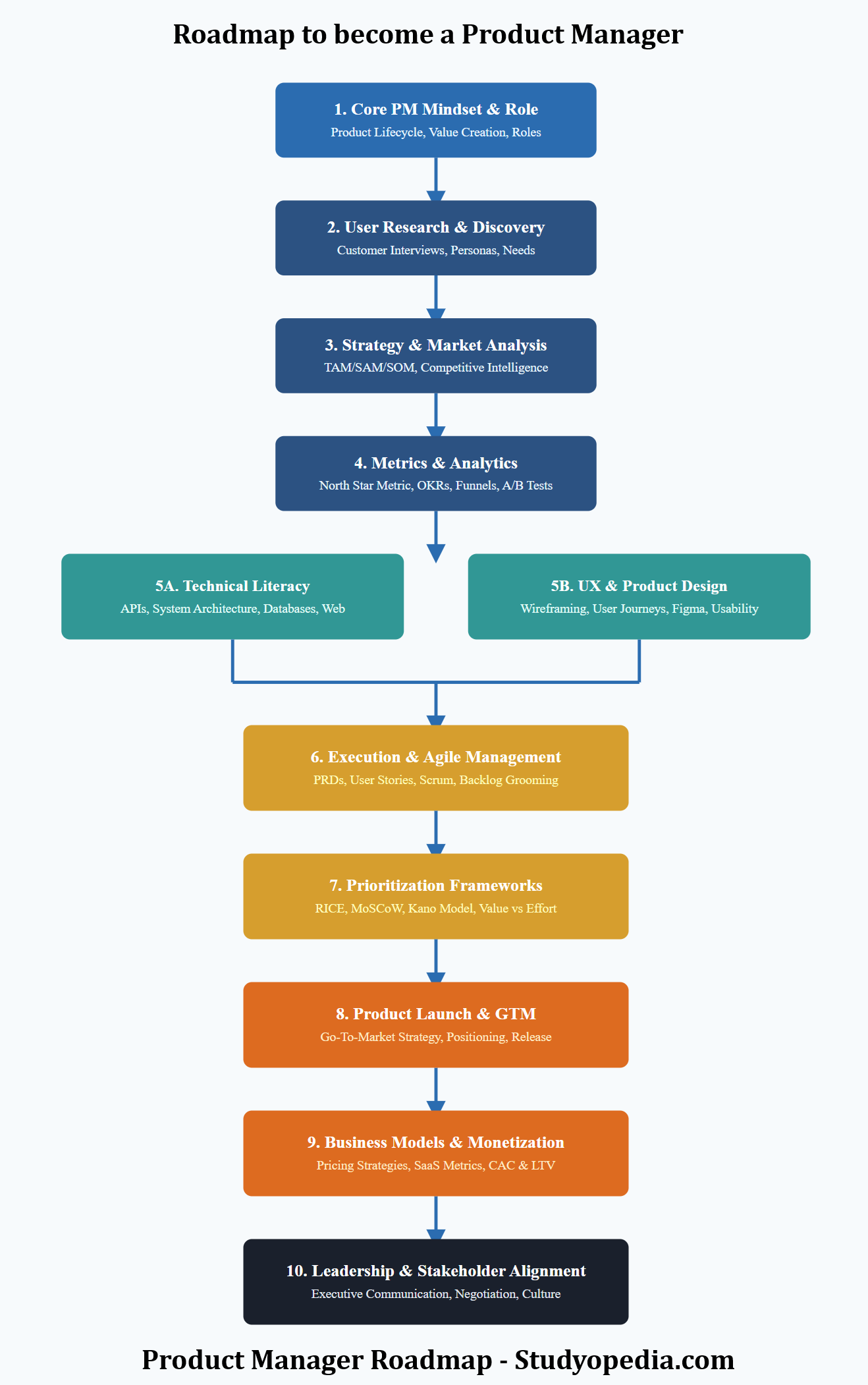
Step-by-Step Product Manager Roadmap
1. Core PM Mindset and Fundamentals
Understanding the role of a Product Manager is the first step. A PM leads through influence rather than authority, bridging communications across technical and business teams.
- Role Responsibilities: Differentiating Product Managers from Project Managers, Product Owners, and Program Managers.
- Product Lifecycle Management: Guiding products through Introduction, Growth, Maturity, and Decline stages.
- Problem-First Thinking: Focusing deeply on user pain points before jumping into solution designs.
2. User Research and Product Discovery
Great products start with deep user empathy. Discovery techniques validate hypotheses before spending developer resources on execution.
- Customer Interviewing: Conducting unbiased qualitative interviews to extract authentic customer insights.
- User Personas and Empathy Mapping: Synthesizing research into clear user profiles and journey maps.
- Continuous Discovery Frameworks: Building weekly touchpoints with target users to maintain ongoing feedback loops.
3. Product Strategy and Market Analysis
Product strategy defines how an organization intends to achieve its long-term vision while competing effectively in the market.
- Market Sizing: Calculating Total Addressable Market (TAM), Serviceable Addressable Market (SAM), and Serviceable Obtainable Market (SOM).
- Competitive Analysis: Mapping market positioning, feature parity matrices, and identifying sustainable differentiators.
- Value Proposition Canvas: Aligning product features directly with customer gain creators and pain relievers.
4. Metrics, Data Analytics, and Experimentation
Data-informed product management validates whether software changes actually move business goals forward.
- Goal Setting Frameworks: Defining a clear North Star Metric supported by Objectives and Key Results (OKRs).
- Product Analytics Tools: Setting up event tracking in Mixpanel, Amplitude, or Google Analytics 4.
- Funnel Analysis and A/B Testing: Analyzing user conversion drop-offs and running statistically valid experiments.
Key Insight for Product Managers
Your primary goal is not to ship the maximum number of features. Your job is to maximize value delivered to customers while minimizing effort spent by engineering and design teams.
5. Technical Literacy and UX Design Basics
While PMs do not write production code or create final UI assets, fluency in both domains builds credibility with cross-functional partners.
- Technical Architecture Basics: Understanding client-server communication, REST APIs, databases, microservices, and system constraints.
- UX Design Fundamentals: Information architecture, wireframing workflows using Figma, and usability testing best practices.
- Design System Integration: Working efficiently with standardized UI component libraries.
6. Execution and Agile Product Management
Turning strategy into shipped software requires structured execution and clear technical documentation.
- Product Requirements Documents (PRDs): Writing concise PRDs that clearly articulate user problems, requirements, edge cases, and success metrics.
- Agile and Scrum Methodologies: Leading sprint planning, backlog grooming, daily standups, and retrospective meetings.
- User Story Crafting: Writing user stories using standard formats along with unambiguous acceptance criteria.
7. Prioritization Frameworks
Feature requests always exceed engineering capacity. PMs use structured models to make objective trade-offs.
- RICE Scoring Model: Evaluating features based on Reach, Impact, Confidence, and Effort calculations.
- Kano Model: Categorizing features into Basic Expectations, Performance Needs, and Delighters.
- MoSCoW and Value vs Effort: Triaging roadmap items into Must-have, Should-have, Could-have, and Won’t-have.
8. Product Launch and Go-To-Market (GTM) Strategy
A great feature creates zero impact if target customers never discover or adopt it.
- Go-To-Market Alignment: Partnering with Product Marketing, Sales, and Support teams to prepare enablement collateral.
- Release Management: Coordinating alpha tests, beta programs, feature flags, and phased rollouts.
- Post-Launch Evaluation: Measuring adoption rates, initial retention, and collecting early post-release user feedback.
9. Business Models, Monetization, and SaaS Economics
A Product Manager must understand how product decisions directly influence corporate financial health.
- Monetization Models: Subscriptions, freemium, usage-based pricing, tiering strategies, and marketplace commissions.
- Key SaaS Metrics: Tracking Customer Acquisition Cost (CAC), Lifetime Value (LTV), Monthly Recurrent Revenue (MRR), and Churn Rate.
- Unit Economics Optimization: Improving the LTV to CAC ratio to ensure scalable revenue growth.
10. Leadership and Stakeholder Alignment
As product leaders progress, soft skills and strategic alignment become the dominant drivers of success.
- Stakeholder Management: Managing expectations across executive leadership, engineering managers, sales, and legal teams.
- Executive Communication: Presenting concise roadmap updates and product proposals to leadership teams.
- Building Product Culture: Fostering cross-functional trust, psychological safety, and continuous learning within teams.
Conclusion and Next Steps
Becoming an effective Product Manager requires balancing continuous user discovery with disciplined execution. Begin by mastering user research and user story creation. As your confidence grows, deepen your data analytics proficiency and business acumen to drive long-term product impact.
If you liked the tutorial, spread the word and share the link and our website, Studyopedia, with others.
For Videos, Join Our YouTube Channel: Join Now
Recommended Posts

No Comments