

27 Sep Data Lakes vs. Data Warehouses: What’s the Difference?
Data Lakes
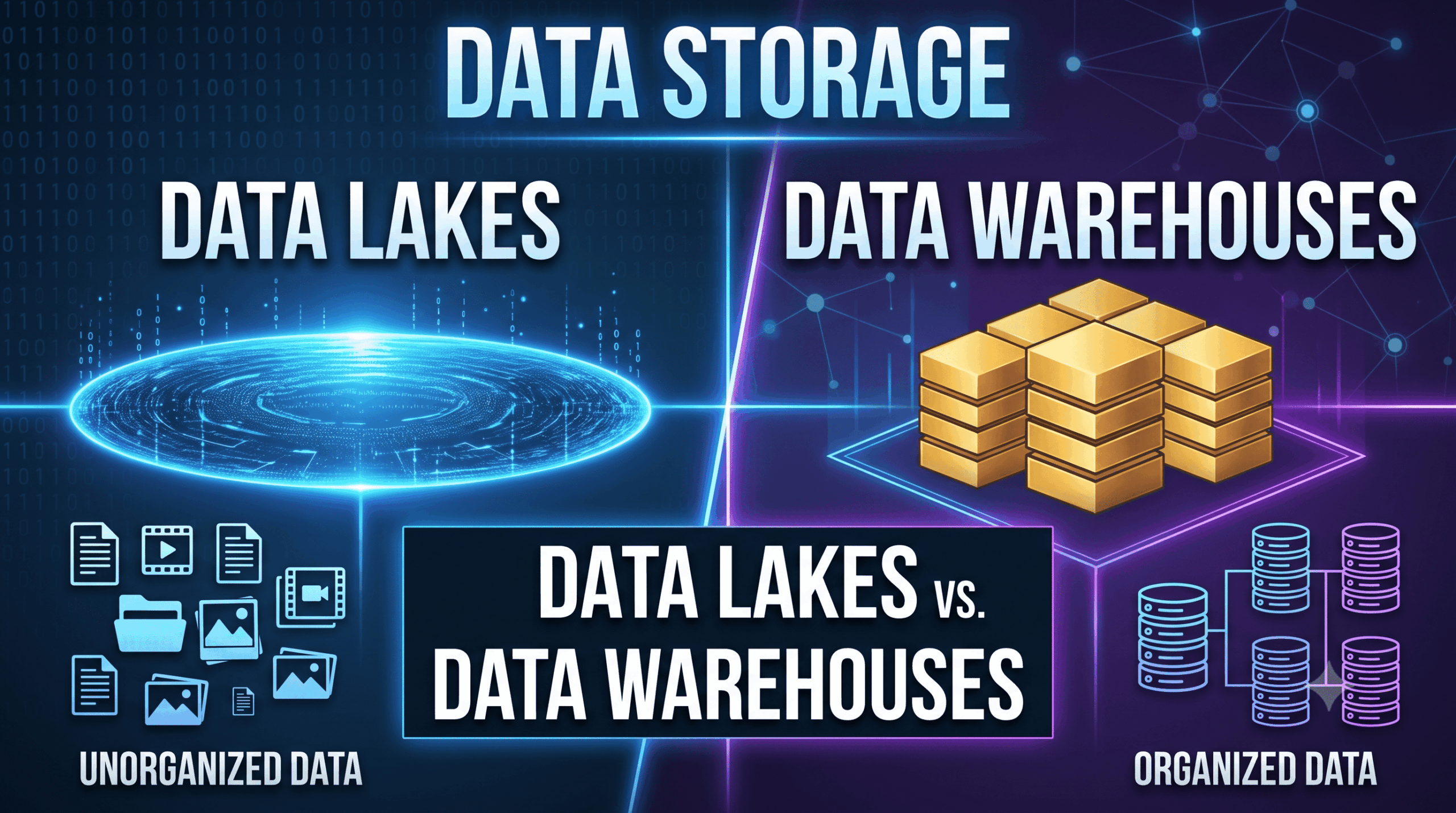
A Data Lake is a centralized storage repository designed to store vast volumes of raw, unstructured, semi-structured, and structured data at scale. It retains data in its native format without requiring an upfront schema (Schema-on-Read), making it flexible for advanced data science, machine learning, and raw telemetry analysis. Solutions like AWS S3 and Azure Data Lake serve as common underlying storage layers.
- Focus: Centralized repositories engineered to ingest and store vast volumes of raw, unrefined data in its native format—including structured (tables), semi-structured (JSON, CSV, logs), and completely unstructured formats (images, audio, video, sensor streams).
- Difference from Data Warehouses: Data Lakes operate on a Schema-on-Read model, meaning data is stored without prior cleaning, structuring, or transformation—the structure is defined only when the data is queried or processed. Data Warehouses, by contrast, enforce a Schema-on-Write model, requiring data to be heavily cleaned, transformed, and structured into rigid relational models before it can be ingested. Additionally, Data Lakes prioritize low storage costs for massive petabyte-scale raw assets (ideal for data science and machine learning), whereas Data Warehouses prioritize high-performance SQL querying for business analytics.
Data Warehouses
A Data Warehouse is a centralized relational database system optimized for analytical processing (OLAP) and business intelligence reporting. It ingests data from operational sources, structures it through defined schemas (Schema-on-Write), and optimizes it for complex analytical SQL queries. Platforms like Snowflake and BigQuery enable organizations to derive actionable business metrics from consolidated enterprise data.
- Focus: Enterprise databases highly optimized for fast SQL analytics, business intelligence (BI), and structured reporting using curated, relational data models (like star or snowflake schemas).
- Difference from Data Lakes: Data Warehouses store strictly structured and transformed data that has passed through ETL (Extract, Transform, Load) pipelines to ensure consistency, high quality, and fast query execution. Unlike Data Lakes—which accommodate raw, semi-structured, and unstructured files for exploratory data science—Data Warehouses are built specifically for business analysts, dashboarding tools (Power BI, Tableau), and predefined corporate reporting.
Frequently Asked Questions (FAQs)
Q1: What is a “Data Lakehouse” and how does it combine both models? A Data Lakehouse (pioneered by platforms like Databricks and modern implementations of Snowflake) is an architecture that blends the best features of both systems. It adds ACID compliance, schema enforcement, and fast SQL query layers directly on top of the cheap, scalable storage of a Data Lake—allowing a single system to serve both business intelligence (warehousing) and machine learning (lakes).
Q2: Can a Data Lake turn into a “Data Swamp”? Yes. Because Data Lakes accept raw data without upfront schema rules or strict validation, they risk becoming a disorganized “Data Swamp” if governance, metadata tagging, and access controls are neglected. When this happens, raw files become untraceable and unusable for analysis.
Q3: Which storage architecture is better for Machine Learning and AI models? Data Lakes (or Lakehouses) are far better suited for machine learning. ML algorithms require raw, unaggregated, and unstructured training data (such as raw text, audio files, image sets, or raw JSON event logs) rather than the highly summarized, tabular data found in traditional Data Warehouses.
If you liked the tutorial, spread the word and share the link and our website, Studyopedia, with others.
For Videos, Join Our YouTube Channel: Join Now
Read More:

No Comments