

27 Sep Docker vs. Kubernetes (Containers vs. Orchestration): What’s the Difference?
Docker (Containers)
Docker is an open-source platform that packages software applications alongside their dependencies into lightweight, isolated containers. By abstracting the underlying host environment, Docker guarantees that applications run consistently across local development machines and cloud servers. It streamlines software deployment workflows by eliminating environment configuration discrepancies.
- Focus: An open-source platform designed to create, package, ship, and run applications inside lightweight, isolated environments called containers that package application code alongside all its dependencies.
- Difference from Kubernetes: Docker operates as a containerization tool focused primarily on a single host machine (or local development environment). It provides the engine to build container images (Dockerfiles), run isolated applications, and handle basic networking between local containers. It does not natively handle complex, multi-server cluster orchestration, self-healing, or automated scaling at scale.
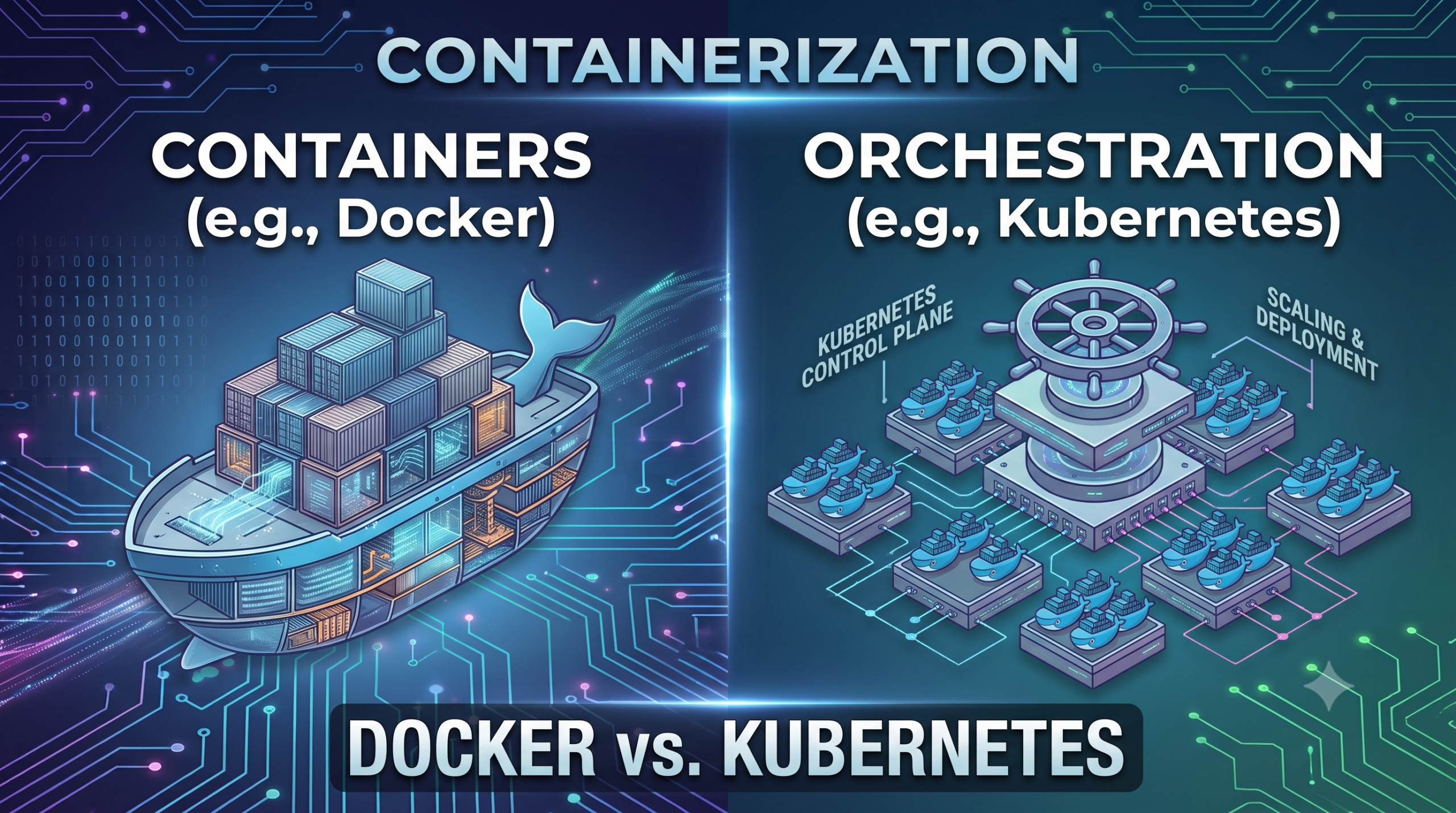
Kubernetes (Orchestration)
Kubernetes (K8s) is an open-source container orchestration platform originally designed by Google to automate application deployment, scaling, and operational management. It manages clusters of containerized workloads, handling self-healing, automated rollouts, traffic load balancing, and dynamic resource allocation. Kubernetes serves as a foundational component for modern cloud-native infrastructures.
- Focus: An enterprise-grade, open-source container orchestration platform (originally developed by Google) designed to automate the deployment, scaling, management, networking, and self-healing of containerized applications across a cluster of multiple servers.
- Difference from Docker: Kubernetes does not create or build application container images itself—it relies on container runtimes to run pre-built container images. Instead, Kubernetes manages the lifecycle and infrastructure surrounding containers. It automatically handles cross-node scheduling, load balancing, rolling zero-downtime updates, self-healing (restarting failed containers), and horizontal auto-scaling across high-availability clusters.
Frequently Asked Questions (FAQs)
Q1: Are Docker and Kubernetes competitors, or do they work together?
They are not direct competitors; they are complementary technologies that serve different stages of the application lifecycle. Developers typically use Docker locally to build and test application container images, and then deploy those same images into a Kubernetes cluster in production to manage scaling, availability, and networking.
Q2: What is Docker Swarm, and how does it compare to Kubernetes?
Docker Swarm is Docker’s native, built-in container orchestration tool. It is significantly simpler to set up and manage than Kubernetes, making it suitable for smaller teams or straightforward multi-container deployments. However, Kubernetes has become the industry standard because it provides far more advanced features for complex, large-scale, multi-cloud enterprise workloads.
Q3: Did Kubernetes “deprecate” Docker?
No, not for end-user developers. In version 1.20+, Kubernetes deprecated Dockershim, an internal translation layer that allowed Kubernetes to talk directly to the full Docker Engine daemon as its underlying runtime. Kubernetes now uses standardized container runtimes (like containerd or CRI-O) directly. Images built using Docker are OCI (Open Container Initiative) compliant, meaning they run seamlessly inside Kubernetes.
If you liked the tutorial, spread the word and share the link and our website, Studyopedia, with others.
For Videos, Join Our YouTube Channel: Join Now
Read More:

No Comments