

27 Sep Quantum Computing vs. Classical Computing: What’s the Difference?
Classical Computing
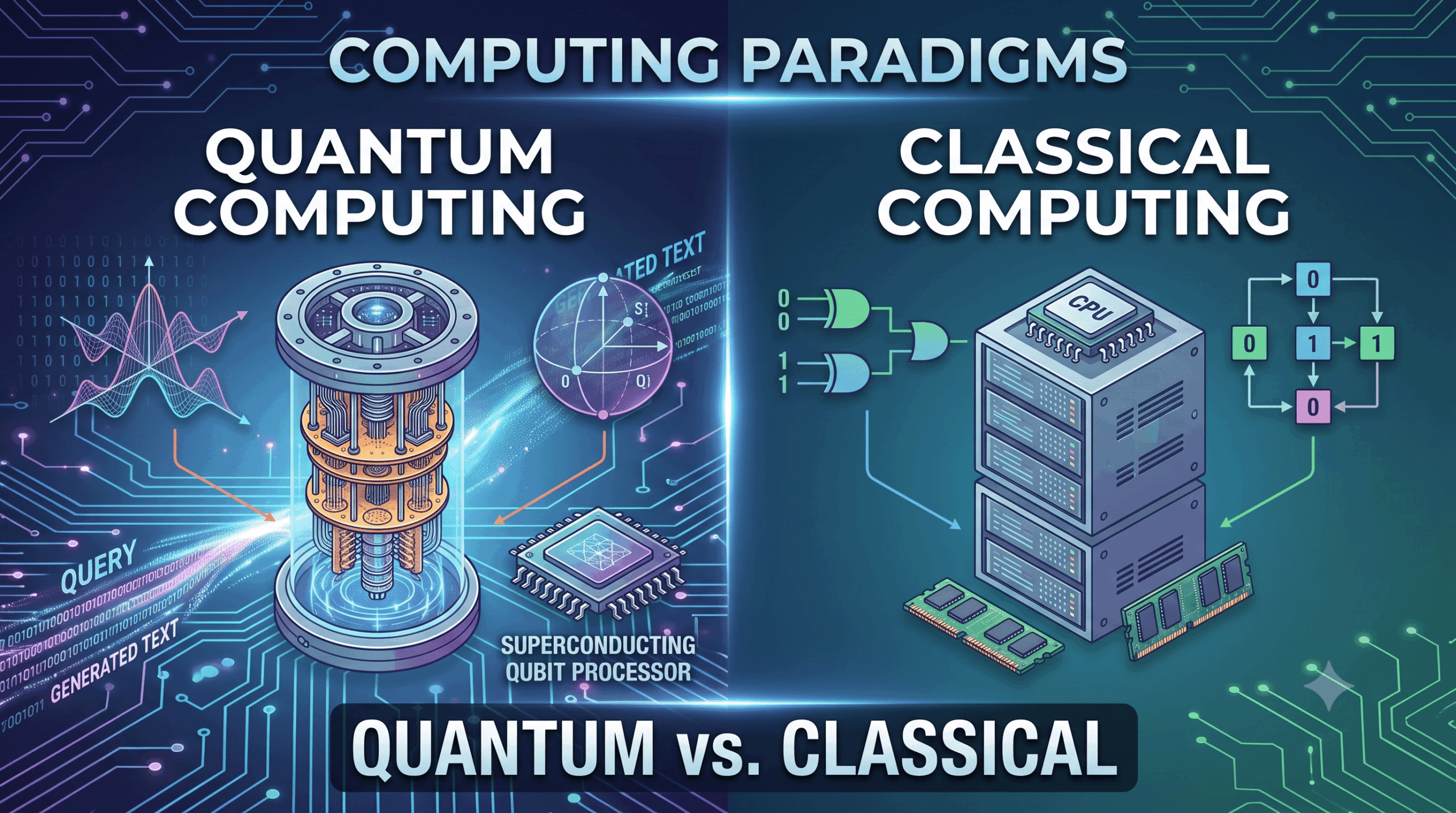
Classical Computing is the standard computing framework built on deterministic physical transistors that represent data strictly as binary bits (0 or 1). Operating through Boolean logic gates, classical hardware processes sequential operations reliably across everyday applications, enterprise servers, and consumer electronics. While bounded by traditional mathematical constraints, classical systems remain the foundation for global digital computing needs.
- Focus: Standard, deterministic computing infrastructure built on physical transistors that manipulate information in binary bits, where every bit exists in a fixed, definite state of either
0or1. - Difference from Quantum Computing: Classical computers process tasks sequentially or through standard parallel processing, executing algorithms deterministically step-by-step. They evaluate single logical combinations one at a time and excel at general-purpose tasks like running operating systems, standard database operations, consumer apps, and daily web browsing. While classical supercomputers are powerful, they scale linearly or polynomially, making them inefficient when trying to calculate exponentially large combination spaces (such as molecular folding or prime factorization of massive numbers).
Quantum Computing
Quantum Computing is an emerging computational paradigm that utilizes the principles of quantum mechanics—specifically superposition and entanglement—to perform parallel calculations. Instead of binary bits, it processes data using quantum bits (qubits) that can exist simultaneously in multiple probabilistic states. This approach allows quantum systems to solve complex mathematical problems, simulate molecular structures, and break traditional cryptographic codes faster than standard computers.
- Focus: Advanced computing systems that leverage principles of quantum mechanics—specifically superposition, entanglement, and quantum interference—to process complex, multi-variable information simultaneously using qubits (quantum bits).
- Difference from Classical Computing: Quantum computers do not restrict data to discrete
0or1states. Through superposition, a qubit can exist in a continuum of states combining both0and1at the same time, allowing a quantum system to evaluate an exponential number of possibilities simultaneously. Through entanglement, qubits become interconnected so that the state of one instantly influences another, enabling quantum algorithms (like Shor’s or Grover’s) to solve specific mathematical and optimization problems in seconds that would take classical supercomputers thousands of years. However, quantum systems require near-absolute-zero cryogenic cooling, suffer from quantum decoherence (high error rates), and cannot replace classical computers for standard daily computing.
Frequently Asked Questions (FAQs)
Q1: Will Quantum Computers ever replace home desktop PCs or smartphones? No. Quantum computers are not designed to be general-purpose replacements for consumer devices. They require extreme operating environments (temperatures near absolute zero) and specialized hardware to maintain quantum states. Classical computers will remain the standard for daily software, video streaming, office tasks, and user interfaces, while quantum computers will operate primarily in cloud environments for complex research and optimization.
Q2: How does Quantum Computing threaten current RSA internet encryption? Modern public-key encryption (like RSA) relies on the extreme difficulty classical computers face when attempting to factor large prime numbers. A sufficiently powerful, fault-tolerant quantum computer running Shor’s Algorithm can factor these numbers exponentially faster, effectively breaking traditional RSA and ECC encryption. This threat has driven the global cybersecurity transition toward Post-Quantum Cryptography (PQC) algorithms designed to resist quantum attacks.
Q3: What real-world applications benefit most from Quantum Computing? Quantum computers excel at problems involving high-dimensional combinatorial spaces, including:
-
Molecular Modeling & Material Science: Simulating exact atomic interactions to discover new pharmaceuticals, batteries, or catalysts.
-
Optimization Problems: Calculating optimal global supply chain routes, financial portfolio risk, and traffic networks.
-
Complex Data Analysis: Accelerating specific machine learning linear algebra kernels and cryptography research.
If you liked the tutorial, spread the word and share the link and our website, Studyopedia, with others.
For Videos, Join Our YouTube Channel: Join Now
Read More:

No Comments