

27 Sep REST vs. GraphQL vs. gRPC: What’s the Difference?
REST (Representational State Transfer)
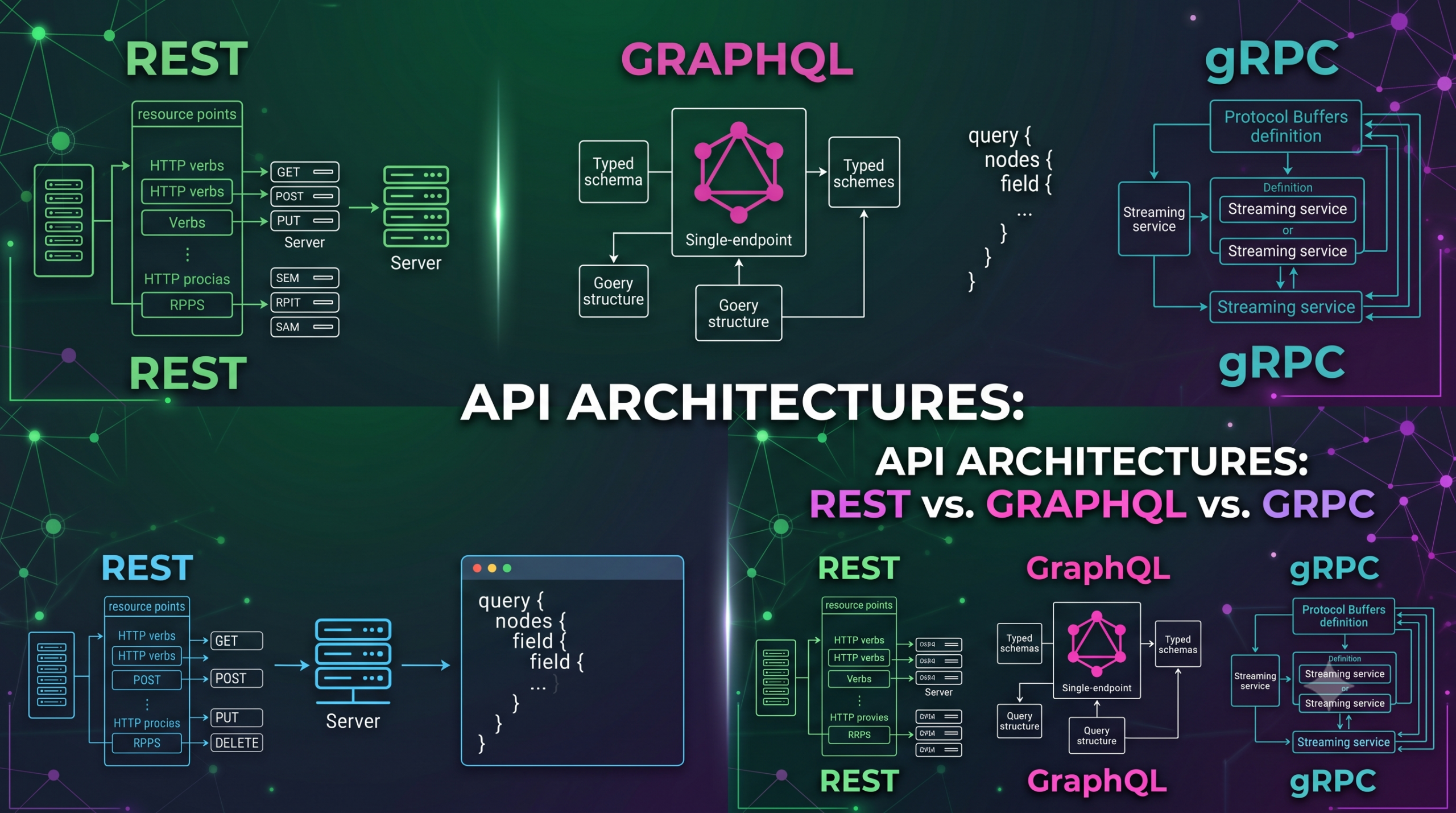
REST (Representational State Transfer) is an architectural style that relies on standard HTTP methods (GET, POST, PUT, DELETE) to manage web resources. It leverages standard JSON payloads and stateless communication patterns, making it the default standard for public web APIs. However, applications can encounter over-fetching or under-fetching issues as client requirements scale.
- Focus: A resource-oriented, stateless architectural style that utilizes standard HTTP methods (GET, POST, PUT, DELETE) and human-readable formats (typically JSON) to manipulate data at fixed URL endpoints.
- Difference from GraphQL: REST relies on rigid, pre-defined server endpoints where each request returns a fixed payload, often causing over-fetching (getting fields you don’t need) or under-fetching (requiring multiple HTTP calls for related data). GraphQL uses a single dynamic endpoint where the client specifies the exact structure of data it wants in a single request.
- Difference from gRPC: REST communicates using text-based JSON/XML messages over standard HTTP/1.1 with stateless resource URLs. gRPC communicates using lightweight binary Protocol Buffers over high-performance HTTP/2 with strongly typed RPC procedure calls designed primarily for microservice communication.
GraphQL
GraphQL is an API query language and server runtime developed by Meta that allows client applications to request precisely the data they need. Clients specify explicit field requirements in a single request, eliminating unwanted data overhead and preventing multiple round trips. Its single-endpoint layout and strong typing system offer significant flexibility for frontend teams.
- Focus: A query language and server-side runtime created by Meta that allows clients to request exactly the data they need through a flexible, typed schema over a single API endpoint.
- Difference from REST: GraphQL solves over-fetching and under-fetching by enabling clients to declaratively request nested resources across schemas in one round trip, contrasting with REST’s static multi-endpoint structure.
- Difference from gRPC: GraphQL focuses on flexible, UI-driven data aggregation and front-end state management, whereas gRPC focuses on raw serialization speed, strict service contracts, and low-latency microservice pipelines.
gRPC (Google Remote Procedure Call)
gRPC is a high-performance, open-source Remote Procedure Call framework created by Google to connect modern microservice architectures. It utilizes Protocol Buffers (Protobuf) for compact binary serialization and runs over HTTP/2 to enable multiplexed stream communication. Its low network latency makes it an ideal fit for internal microservices and real-time backend systems.
- Focus: An open-source, high-performance RPC framework built on HTTP/2 and Protocol Buffers (Protobuf) that allows applications to call methods on remote servers as if they were local functions.
- Difference from REST: gRPC strips away human-readable text payloads in favor of compact, binary-serialized Protocol Buffers delivered over multiplexed HTTP/2 streams, achieving significantly lower latency and bandwidth usage than REST.
- Difference from GraphQL: gRPC requires strict, pre-compiled schema files (
.proto) and statically typed client-server interfaces designed for fast service-to-service calls, rather than accepting flexible, arbitrary client-defined queries at runtime like GraphQL.
Frequently Asked Questions (FAQs)
Q1: Can a modern application use REST, GraphQL, and gRPC at the same time? Yes, this is common in microservices architecture. Many systems use gRPC for low-latency, high-frequency internal communication between microservices, GraphQL for client-facing mobile or web apps that need flexible data fetching, and public-facing REST endpoints for external third-party developer integrations.
Q2: Why isn’t gRPC used universally for public web frontends? Browser support for HTTP/2 primitives and binary transport isn’t natively exposed to standard client JavaScript in the same direct way traditional HTTP requests are. While client libraries like gRPC-Web exist, they require a proxy (like Envoy) to translate traffic, making REST and GraphQL far easier to consume directly in browsers.
Q3: Is REST outdated because of GraphQL and gRPC? No. REST remains the industry standard for public-facing APIs, webhooks, and third-party integrations due to its simplicity, universal support, ease of caching (via standard HTTP headers), and lack of specialized client-side tooling requirements.
If you liked the tutorial, spread the word and share the link and our website, Studyopedia, with others.
For Videos, Join Our YouTube Channel: Join Now
Read More:

No Comments