

27 Sep 5G vs. 6G vs. Wi-Fi 7: What’s the Difference?
5G (Fifth-Generation Cellular)
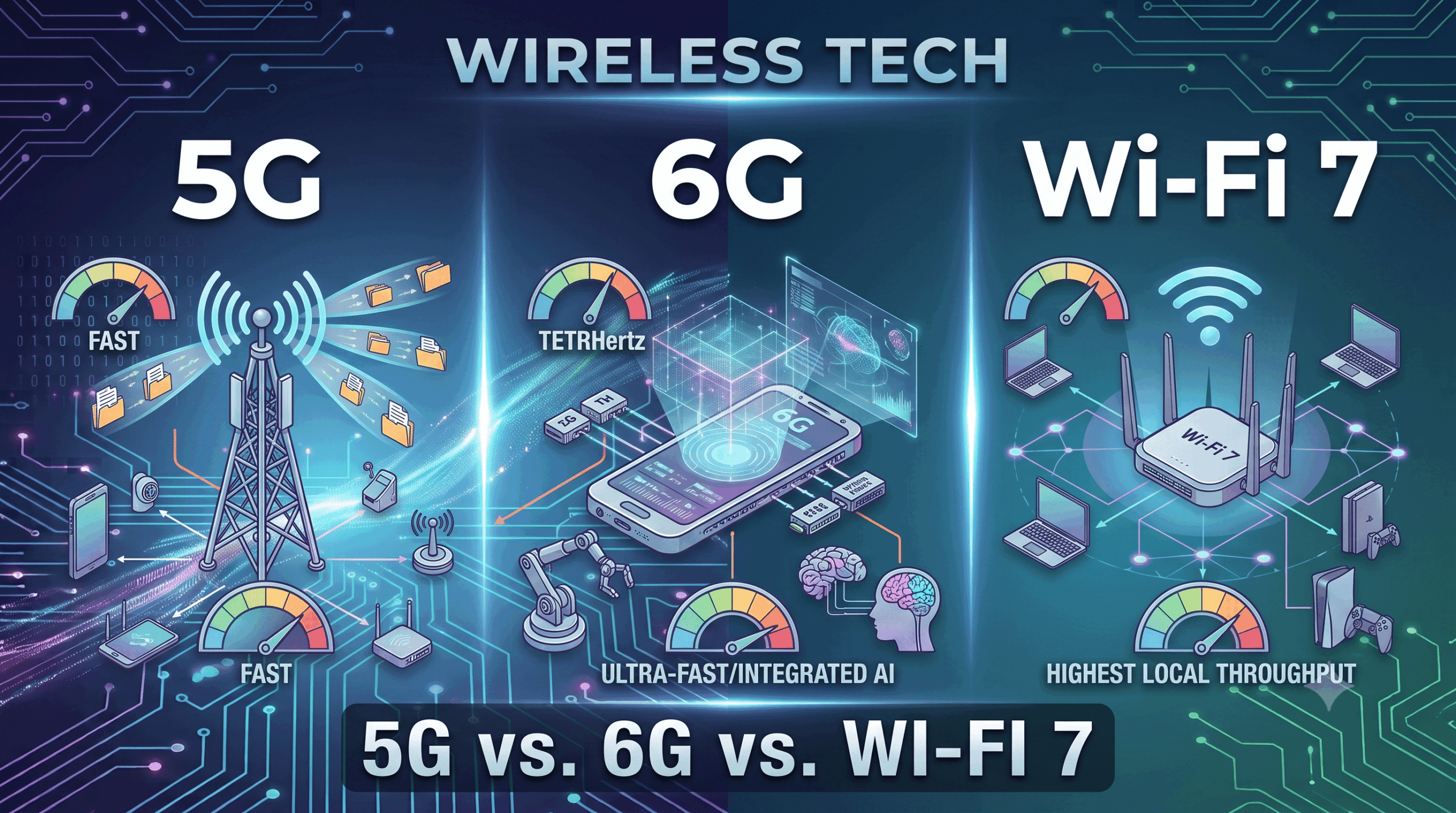
5G is the fifth generation of cellular network technology, offering significant improvements in bandwidth, connection density, and operational latency compared to 4G. Utilizing millimeter-wave and sub-6 GHz spectrums, it supports high-density mobile broadband alongside critical Internet of Things (IoT) deployments. It provides the infrastructure needed for real-time mobile services, edge computing, and smart manufacturing systems.
- Focus: The global mobile cellular standard operated over licensed radio spectrum, designed to provide broad-area coverage, high-speed mobile data, low latency, and massive Internet of Things (IoT) connectivity across sub-6 GHz and millimeter-wave (mmWave) bands.
- Difference from 6G: 5G provides real-world commercial cellular connectivity with target speeds up to 10–20 Gbps and latencies around 1 millisecond. 6G is designed to expand into sub-terahertz frequencies and the cmWave (FR3) spectrum to achieve sub-millisecond latencies, terabit-per-second peak speeds, and integrated space-air-ground satellite networks.
- Difference from Wi-Fi 7: 5G is a carrier-managed wide area network (WAN) operating on licensed spectrum across nationwide towers to maintain seamless mobile handoffs across miles. Wi-Fi 7 is a localized wireless local area network (WLAN) operating on unlicensed spectrum within short-range indoor or campus environments.
6G (Sixth-Generation Cellular)
6G is the upcoming sixth-generation wireless standard, designed to integrate satellite-terrestrial networks with native artificial intelligence capabilities. Targeted for early commercial deployments around 2030, it aims to achieve terabit-per-second data rates, sub-millisecond latencies, and spatial sensing features. This standard will support futuristic use cases like real-time spatial computing, autonomous transport networks, and micro-second remote controls.
- Focus: The next-generation global mobile communication architecture designed around AI-native networks, sub-terahertz/cmWave spectrum, spatial sensing, and seamless integration between terrestrial base stations and non-terrestrial satellite systems.
- Difference from 5G: 6G moves beyond traditional cellular data delivery by embedding artificial intelligence directly into the physical radio access layer (AI-RAN), offering up to 10x higher device density, centimeter-level positioning accuracy, and joint communication and sensing (JCAS) capabilities.
- Difference from Wi-Fi 7: 6G is a carrier-orchestrated cellular standard engineered for seamless macro-mobility (supporting high-speed transport like bullet trains up to 1,000 km/h and global coverage), whereas Wi-Fi 7 is designed for short-range stationary or local room-scale data throughput managed by local access points.
Wi-Fi 7 (IEEE 802.11be)
Wi-Fi 7 (IEEE 802.11be) is a short-range wireless networking standard designed to deliver extreme throughput and reduced connection latency across 2.4 GHz, 5 GHz, and 6 GHz bands. Introducing 320 MHz channel widths, 4096-QAM modulation, and Multi-Link Operation (MLO), it allows devices to transmit data over multiple bands simultaneously. This technology handles high-density traffic demands for 8K video streaming, immersive XR experiences, and low-latency gaming setups.
- Focus: The ultra-high-throughput wireless local area network standard designed for extremely fast, low-latency indoor data transfer across unlicensed 2.4 GHz, 5 GHz, and 6 GHz spectrum bands.
- Difference from 5G: Wi-Fi 7 uses features like Multi-Link Operation (MLO) to aggregate multiple unlicensed spectrum channels simultaneously inside a building, whereas 5G manages cellular traffic via licensed, carrier-controlled spectrum over public cellular towers.
- Difference from 6G: Wi-Fi 7 provides local-area wireless coverage designed for private routers, local mesh setups, and immediate venue capacity. 6G is a public telecommunications framework engineered to manage global infrastructure, satellite networks, and wide-area cellular roaming across entire cities and rural regions.
Frequently Asked Questions (FAQs)
Q1: Will Wi-Fi 7 replace 5G, or do they complement each other? They are strictly complementary. Wi-Fi 7 handles heavy indoor throughput (e.g., home networks, office buildings, stadium Wi-Fi) over short distances using free, unlicensed spectrum. 5G handles outdoor mobility, public infrastructure, and wide-area coverage where devices move continuously between cell towers. Most modern mobile devices use both simultaneously.
Q2: When will 6G become publicly available? While global 3GPP standards bodies and research groups are actively defining specifications, commercial 6G networks are expected to begin deployment around 2030. 5G and 5G-Advanced will remain the primary global cellular infrastructure until then.
Q3: What makes Multi-Link Operation (MLO) in Wi-Fi 7 a major technical leap? In older Wi-Fi generations (like Wi-Fi 6), a device could only connect to a single band at a time (either 2.4 GHz, 5 GHz, or 6 GHz). Wi-Fi 7’s MLO allows a single device to transmit and receive data across multiple frequency bands simultaneously. This dramatically drops latency, bypasses local channel congestion, and boosts real-time reliability for applications like AR/VR and cloud gaming.
If you liked the tutorial, spread the word and share the link and our website, Studyopedia, with others.
For Videos, Join Our YouTube Channel: Join Now
Read More:

No Comments