

27 Sep CPU vs. GPU vs. TPU: What’s the Difference?
CPU (Central Processing Unit)
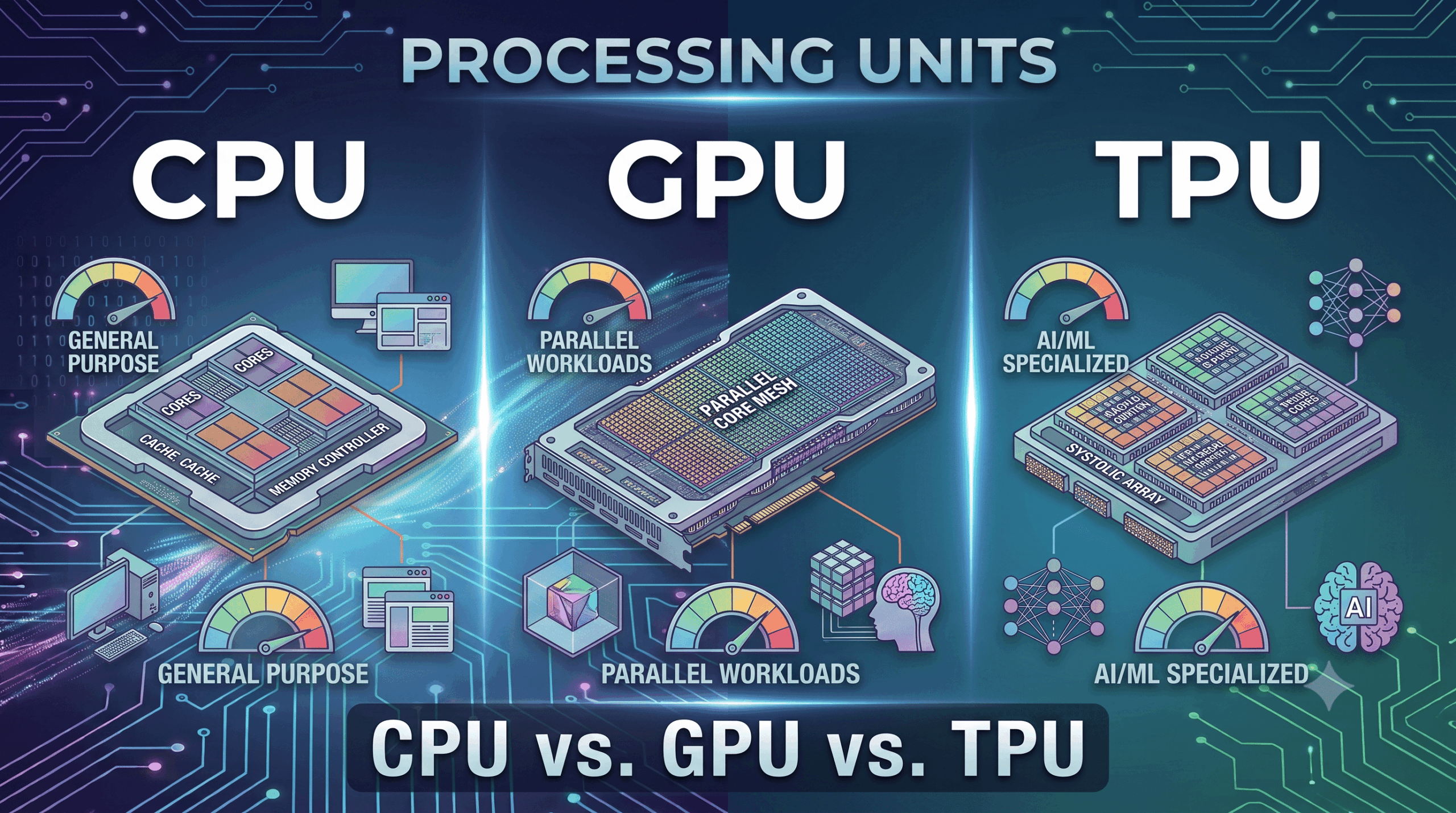
A Central Processing Unit (CPU) is the general-purpose execution core responsible for managing an operating system and executing diverse software instructions. Designed with a few specialized cores optimized for low-latency, sequential processing, it excels at handling complex logical branching tasks. It serves as the main coordinator for all hardware components across desktop and server environments.
- Focus: A general-purpose processor optimized for executing complex sequential logic, managing system resources, and coordinating low-latency operations across the entire operating system.
- Difference from GPU: CPUs feature a small number of powerful cores built to handle single-threaded performance and intricate control flow. In contrast, GPUs feature thousands of smaller, highly parallel cores optimized for massive vector processing rather than sequential task execution.
- Difference from TPU: CPUs rely on a general-purpose instruction set architecture (like x86 or ARM) designed for versatile software execution. TPUs are specialized Application-Specific Integrated Circuits (ASICs) designed exclusively to execute matrix operations for neural networks, lacking the ability to run operating systems or general software.
GPU (Graphics Processing Unit)
A Graphics Processing Unit (GPU) is a massively parallel processor optimized for handling thousands of mathematical operations simultaneously. Originally built for 3D graphics rendering, its parallel compute architecture makes it an essential engine for training deep learning models and executing matrix arithmetic. GPUs form the hardware backbone of modern AI training pipelines and compute clusters.
- Focus: A highly parallel, programmable processor originally engineered to render 3D graphics that has evolved into the industry standard for general-purpose parallel computing (GPGPU), scientific simulations, and deep learning.
- Difference from CPU: GPUs trade single-core sequential speed and complex branch prediction for massive throughput, using thousands of concurrent cores (e.g., CUDA or Stream Processors) to process matrix and vector data simultaneously.
- Difference from TPU: GPUs rely on a general programmable core architecture with software-managed instruction pipelines (such as CUDA or OpenCL) to support diverse math workloads. TPUs use a hardwired systolic array architecture designed specifically for matrix multiplication, allowing data to flow directly across processing units without fetching instructions for every step.
TPU (Tensor Processing Unit)
A Tensor Processing Unit (TPU) is an Application-Specific Integrated Circuit (ASIC) designed by Google to accelerate artificial intelligence workloads. Optimized specifically for tensor math operations, it accelerates matrix multiplication tasks with lower energy consumption than traditional processors. TPUs power cloud-based AI systems across Google Cloud and internal machine learning infrastructures.
- Focus: An Application-Specific Integrated Circuit (ASIC) custom-designed by Google specifically to accelerate the linear algebra (tensor operations) that underpins deep learning training and inference.
- Difference from CPU: TPUs strip away general-purpose computing components like complex caches and instruction decoders to dedicate maximum silicon area directly to matrix multiplication, making them incapable of managing standard operating system tasks.
- Difference from GPU: TPUs are custom ASICs optimized for high-throughput tensor operations and high-bandwidth interconnects (like TPU Pods), offering high performance-per-watt for massive deep learning workloads (e.g., LLMs and Transformers). However, unlike GPUs—which can be purchased for on-premise hardware and support a wide variety of parallel software—TPUs are proprietary and accessed primarily through cloud infrastructure.
Frequently Asked Questions (FAQs)
Q1: Can an AI system run without a CPU if it uses GPUs or TPUs? No. GPUs and TPUs act as accelerator co-processors; they still require a host CPU to manage the operating system, handle data storage I/O, orchestrate memory distribution, and feed raw data batches into the accelerator cards.
Q2: Why are GPUs more widely used for AI training than TPUs across the industry? GPUs—particularly from vendors like NVIDIA—offer broad availability (both on-premise and across every major cloud provider) alongside a mature software ecosystem (CUDA, PyTorch). TPUs are proprietary chips primarily available through Google Cloud, meaning organizations requiring multi-cloud flexibility or local physical hardware rely on GPUs.
Q3: What makes a TPU faster for matrix multiplication than a general GPU? TPUs use a systolic array design where data flows through a grid of multiply-accumulate units in a continuous cycle without writing intermediate results back to registers or memory. This drastically reduces memory access latency and power consumption compared to GPUs, which fetch operands from memory for each parallel instruction execution cycle.
If you liked the tutorial, spread the word and share the link and our website, Studyopedia, with others.
For Videos, Join Our YouTube Channel: Join Now
Read More:

No Comments