

27 Sep React vs. Vue vs. Angular: What’s the Difference?
React
React is an open-source JavaScript library maintained by Meta, engineered for building interactive user interfaces via a component-based architecture. It uses a Virtual DOM to optimize updates and minimize direct manipulations of the real web page structure. React relies heavily on a flexible ecosystem, leaving state management and routing decisions to third-party packages.
- Focus: A flexible, declarative JavaScript library created by Meta specifically designed for building user interfaces using a component-based architecture and a Virtual DOM.
- Difference from Vue: React relies on JSX (JavaScript XML) and an unopinionated ecosystem where you choose your own routing, state management, and build tools. In contrast, Vue uses a template-based syntax and comes with officially maintained core libraries for state management and routing out of the box.
- Difference from Angular: React is a minimal library that focuses strictly on the view layer, requiring third-party libraries to build a complete application. Angular, on the other hand, is a full, opinionated framework that includes everything needed for enterprise development within its core package.
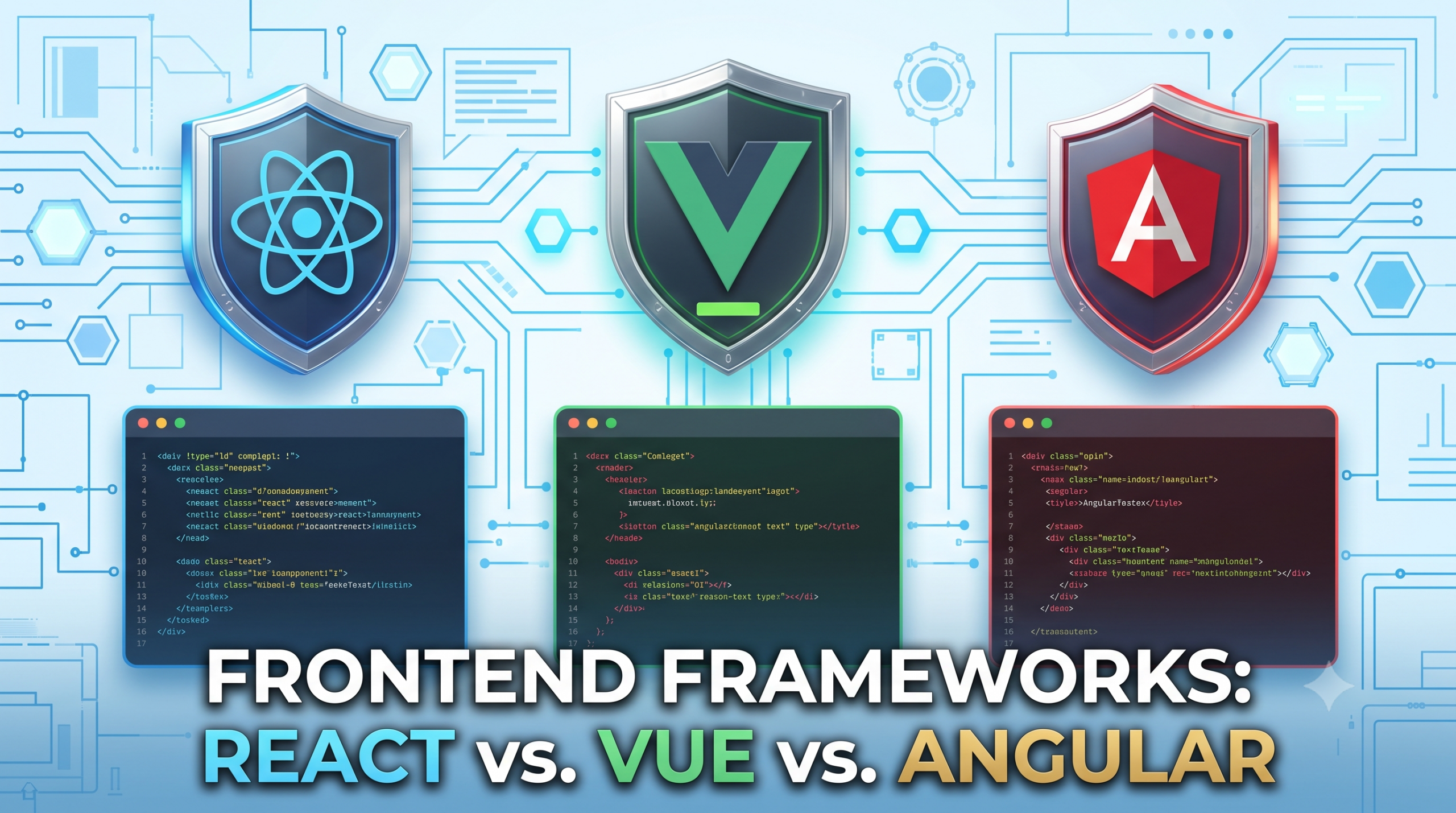
Vue
Vue.js is a progressive JavaScript framework created by Evan You, designed for building web user interfaces incrementally. Its gentle learning curve stems from a template syntax that mirrors standard HTML, along with reactive data-binding features out of the box. Vue balances simplicity and power by providing officially maintained packages for routing and state management.
- Focus: A progressive, approachable framework designed to be incrementally adoptable, making it easy to integrate into existing projects or use for full single-page applications (SPAs).
- Difference from React: Vue provides a gentler learning curve with standard HTML, CSS, and JavaScript separation in single-file components. It also offers official, core-maintained tools for routing and state management, providing clear architectural guidance compared to React’s flexible third-party ecosystem.
- Difference from Angular: Vue is far lighter and less rigid than Angular. It avoids complex enterprise abstractions like dependency injection, decorators, and mandatory TypeScript setups, opting for a simpler reactivity system and smaller bundle size.
Angular
Angular is an enterprise-grade TypeScript framework built and maintained by Google for constructing scalable web applications. It delivers an all-in-one platform out of the box, including dependency injection, robust form validation, client-side routing, and HTTP utilities. Angular enforces strict structural patterns and a opinionated architecture, making it well-suited for team-driven enterprise projects.
- Focus: A comprehensive, enterprise-grade development platform maintained by Google, built from the ground up with TypeScript for large-scale applications.
- Difference from React: Angular is a complete framework that enforces strict architectural rules, TypeScript usage, dependency injection, and complex data flows (using RxJS). React is an unopinionated library that gives developers total freedom to structure their applications as they see fit.
- Difference from Vue: Angular has a much steeper learning curve and higher setup complexity due to its extensive built-in feature set. Vue prioritizes simplicity and lightweight reactivity, whereas Angular provides heavy-duty architecture out of the box for massive team codebases.
Frequently Asked Questions (FAQs)
Q1: Which framework or library is the most popular in the job market?
React consistently holds the largest share of job market demand and community adoption globally. Angular remains a strong second, particularly in large enterprise and corporate environments. Vue has a massive developer following and strong community support, but generally has fewer job postings compared to React.
Q2: Do I have to use TypeScript with React, Vue, and Angular?
Angular strictly requires TypeScript as a core part of its architecture and development workflow. React and Vue both natively support TypeScript, but it is entirely optional—you can build applications in either framework using standard modern JavaScript.
Q3: Which option is best for a beginner learning frontend development?
Vue is widely considered the easiest to start with because it uses standard HTML, CSS, and JavaScript templates that feel familiar to web developers. React is also beginner-friendly due to its simple component model, though learning JSX and choosing setup libraries can add an initial learning step. Angular is usually the hardest for beginners due to its strict patterns, TypeScript requirement, and complex concepts like dependency injection.
If you liked the tutorial, spread the word and share the link and our website, Studyopedia, with others.
For Videos, Join Our YouTube Channel: Join Now
Read More:

No Comments