

14 Oct AI Agents Architecture
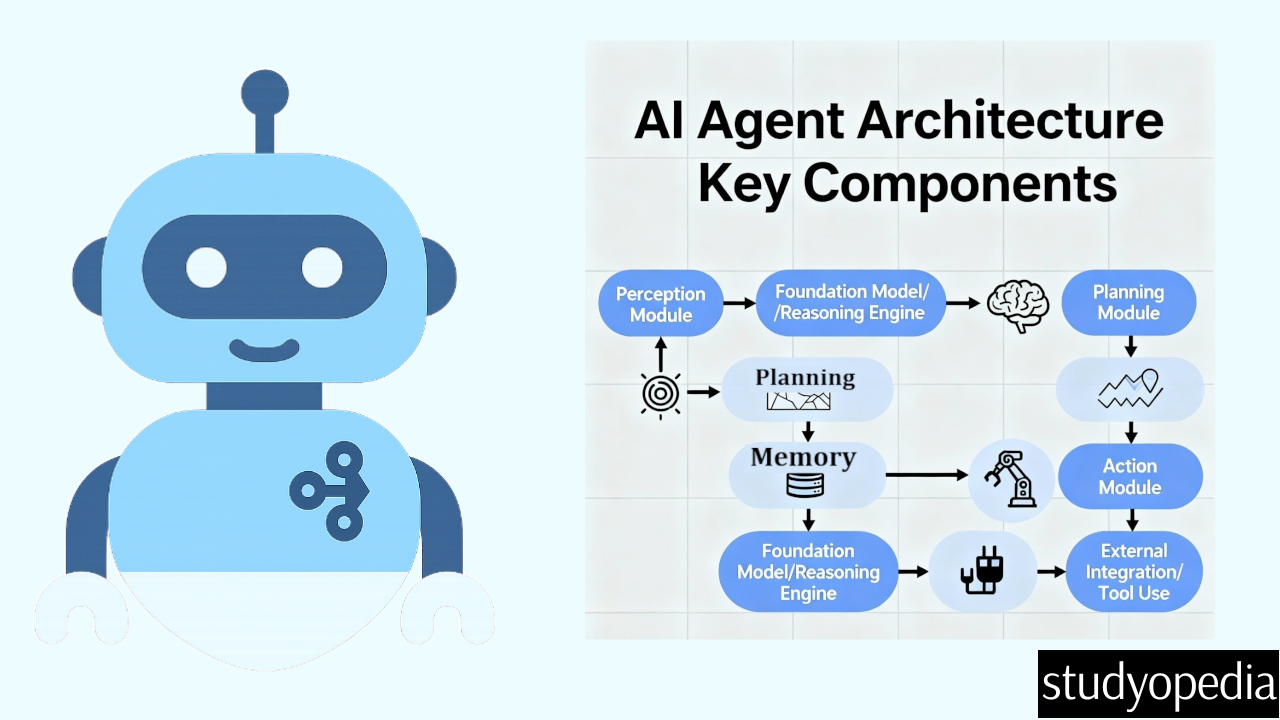
Agents typically have an architecture composed of several key components that enable them to perceive their environment, reason, plan, remember, and act autonomously to achieve goals.
Video Tutorial
The following are the key components of AI Agent Architecture:
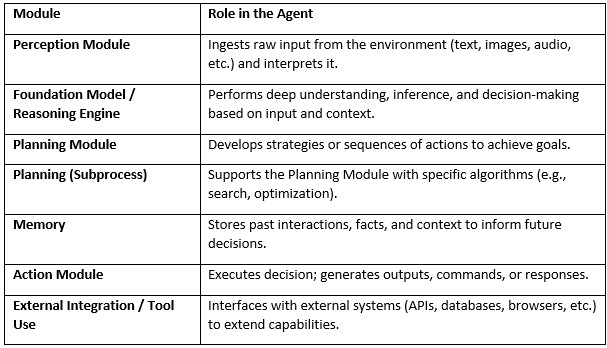
- Foundation Model / Reasoning Engine: At the heart is often a large language model (LLM) or other AI reasoning system that interprets inputs, generates responses, and drives decision-making. This model processes natural language or sensor data and can couple with tools, memory, or external functions for extended capabilities.
- Perception or Profiling Module: This module acts like the agent’s senses, gathering and analyzing information from the environment via sensors (in physical agents) or digital interfaces (in software agents). It filters raw data to extract meaningful signals critical for decision-making.
- Planning Module: Responsible for breaking down goals into smaller tasks, sequencing actions, and evaluating alternatives to select the best course. Methods include symbolic reasoning, task networks, and decision trees. Planning enables agents to operate over longer horizons and handle dependencies among tasks.
- Memory Module: Stores information across sessions including short-term data like interaction context and long-term knowledge such as past experiences or domain knowledge. This supports personalization, context awareness, and learning over time, often implemented with vector databases or knowledge graphs.
- Action Module: Executes decisions made by the planning module, translating them into real-world effects, whether through robotic actuators or digital interfaces.
- External Integration / Tool Use and Routing: Modern agents often integrate external APIs, tools, or sub-agents and include routing mechanisms to delegate or sequence tasks efficiently within complex workflows
The figure below explains it further:
We can summarize the AI Agents architecture as follows:
If you liked the tutorial, spread the word and share the link and our website, Studyopedia, with others.
For Videos, Join Our YouTube Channel: Join Now
Read More:
- Learn Model Context Protocol
- LangChain Tutorial
- RAG Tutorial
- Hugging Face Tutorial
- Deep Learning Tutorial
- Machine Learning Tutorial
- Data Science Tutorial
- Data Analyst Roadmap
- Python Tutorial

No Comments