

16 Sep Technical Mitigation: Algorithmic Audits & Fairness Metrics
While understanding bias conceptually is important, machine learning engineers and data scientists require concrete, quantitative tools to detect, measure, and mitigate unfairness in algorithmic decision-making.
This lesson covers the technical metrics used to audit AI systems and the algorithmic interventions applied across the data science pipeline.
1. Statistical & Mathematical Fairness Metrics
No single definition of “fairness” exists in mathematics. In fact, several standard fairness metrics are mutually exclusive—optimizing for one often mathematically prevents satisfying another.
Let represent the actual outcome, represent the AI’s binary prediction (e.g., 1 = Approved, 0 = Denied), and represent a protected attribute (e.g., gender, race, age).
A. Demographic Parity (Statistical Parity)
Requires that the likelihood of receiving a positive outcome is equal across all protected groups, regardless of the base rate of the actual target:

- Use Case: Hiring screening tools where equal representation across demographics is prioritized.
- Limitation: Ignores qualified differences between groups if actual base rates differ.
B. Equalized Odds
Requires the model to have equal True Positive Rates (TPR) and equal False Positive Rates (FPR) across all protected groups.

- Use Case: High-stakes scoring systems (such as medical risk tools or criminal recidivism predictions) where equal error rates across demographic groups are critical.
C. Predictive Rate Parity (Equalized Precision)
Requires that the Positive Predictive Value (PPV)—the probability that a positive prediction is correct; is equal across groups.

- Use Case: Credit scoring and loan approval algorithms where risk assessments must mean the same thing across all demographic groups.
2. Fairness Metrics Trade-offs & The Impossibility Theorem
A fundamental insight in AI ethics is the Impossibility Theorem of Fairness (proven by Kleinberg et al., 2016).
Key Rule: Except in trivial cases (such as perfect 100% prediction accuracy or identical base rates), an algorithm cannot simultaneously satisfy Demographic Parity, Equalized Odds, and Predictive Rate Parity.
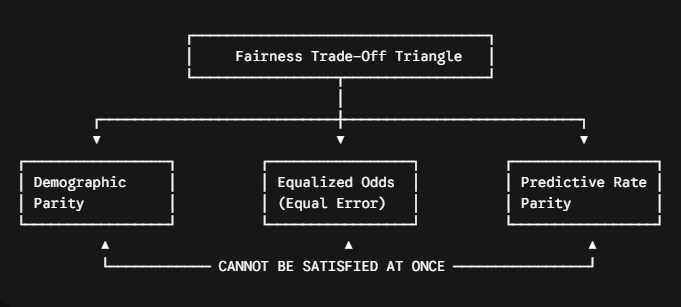
Selecting a fairness metric is not just a mathematical choice; it is an ethical and business decision that determines which group bears the burden of algorithmic error.
3. Algorithmic Interventions (Mitigation Techniques)
Mitigation strategies are divided into three stages based on where they are applied in the machine learning lifecycle:

| Pipeline Stage | Strategy | Description |
| Pre-Processing | Re-weighing & Resampling | Adjusting sample weights or oversampling underrepresented groups in the training dataset prior to model training. |
| Disparate Impact Remover | Editing feature values to remove correlation between non-protected predictors and the protected attribute . | |
| In-Processing | Adversarial Debiasing | Training a neural network simultaneously with an adversary model that attempts to predict protected attributes from internal representations. |
| Constraint-Based Optimization | Adding fairness mathematical constraints directly into the loss function during model training. | |
| Post-Processing | Threshold Adjustment | Applying different decision classification thresholds () to probability scores for different demographic groups to equalize error rates post-prediction. |
4. Algorithmic Auditing Workflows
An algorithmic audit is a systematic evaluation of an automated decision system to assess its fairness, security, and performance across subgroups.
Key Steps in an Audit Pipeline
- Scoping & Context: Define the intended deployment environment, decision impact, and target protected groups.
- Disaggregated Performance Auditing: Evaluating model performance (Accuracy, Precision, Recall, F1-score) broken down by demographic slices rather than relying only on overall aggregate metrics.
- Counterfactual Fairness Testing: Testing whether changing only the protected attribute for a specific data instance alters the model output.
- Documentation & Traceability: Logging dataset lineage, model versioning, and validation checks using standardized frameworks like Datasheets for Datasets and Model Cards.
5. Open-Source Debiasing & Auditing Toolkits
Data science teams leverage open-source libraries to automate bias auditing and mitigation in production pipelines:
- AIF360 (IBM AI Fairness 360): Comprehensive toolkit containing fairness metrics and pre/in/post-processing debiasing algorithms.
- Fairlearn (Microsoft): Python library designed to assess system fairness and mitigate disparity using constrained optimization approaches.
- What-If Tool (Google): Interactive visual interface for analyzing model performance and probing counterfactual scenarios across subgroups.

No Comments