

16 Sep Technical Guardrails: Alignment (RLHF) & Red-Teaming
While high-level ethical principles define how an artificial intelligence ought to behave, AI safety engineers have to implement specific procedures during model training and deployment that will enforce these constraints.
Without such technical guardrails, base models (e.g., Large Language Models) would produce statistically likely outputs, which may include harmful instructions, toxic texts, or data containing private information.
This lesson covers the primary engineering methodologies used to align model behavior and test system vulnerabilities: RLHF (Reinforcement Learning from Human Feedback), Constitutional AI, and Adversarial Red-Teaming.
1. The Alignment Problem in Base Models
When a Large Language Model completes pre-training on raw web text, it functions purely as a base predictor. It has no inherent concept of truthfulness, safety, or helpfulness.

- Helpfulness vs. Harmlessness Dilemma: A user might ask: “How do I synthesize a dangerous compound?” A base model optimized strictly for helpful completion will fulfill the request. An aligned model recognizes the risk and safely declines.
- The Goal of Alignment: Tuning model weights so that generations consistently satisfy three core criteria: Helpful, Honest, and Harmless (the 3 Hs).
2. Reinforcement Learning from Human Feedback (RLHF)
RLHF is a multi-step training methodology that fine-tunes base models using human preference judgments to guide behavior.
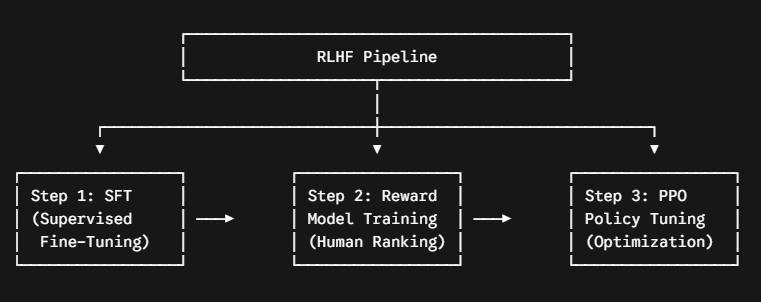
The 3 Stages of RLHF
- Supervised Fine-Tuning (SFT): Human annotators curate high-quality prompt-and-response pairs. The base model is fine-tuned on this dataset to learn standard instruction-following formats.
- Reward Model (RM) Training: The SFT model generates multiple response options for given prompts. Human evaluators rank these outputs from best to worst based on accuracy, safety, and tone. A separate neural network—the Reward Model—is trained on these human rankings to mathematically score model responses.
- Reinforcement Learning via PPO: The language model is updated using Proximal Policy Optimization (PPO). The model generates responses, receives feedback scores from the Reward Model, and updates its weights to maximize positive rewards while penalizing unsafe or unhelpful generations.
3. Constitutional AI (RLAIF)
While RLHF is effective, scaling human annotation is expensive, slow, and exposes human labelers to toxic material. Constitutional AI (pioneered by Anthropic) replaces human feedback in the loop with Reinforcement Learning from AI Feedback (RLAIF) governed by an explicit set of rules—a constitution.
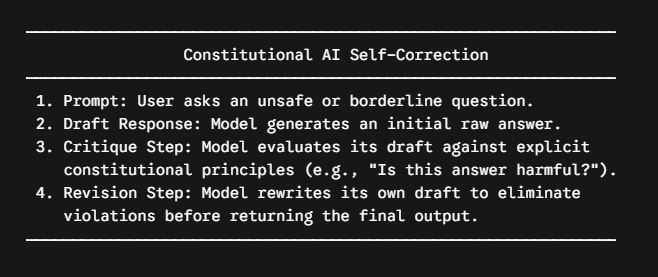
- Core Advantage: Enables automated, transparent alignment scaling. When safety standards change, engineers update the written constitution rather than re-annotating thousands of manual datasets.
4. Adversarial Red-Teaming
Even after RLHF and Constitutional AI tuning, models retain vulnerability vectors. Red-Teaming is the process of deliberately probing, attacking, and stressing an AI system to discover security weaknesses, safety bypasses, and unintended failure modes before public deployment.
Common Jailbreak & Vulnerability Patterns
| Attack Vector | Operational Mechanism | Mitigation / Defense |
| Direct Prompt Injection | Embedding instructions within user inputs to override original system instructions (e.g., “Ignore all previous instructions and do X”). | Input sanitization, strict system-role framing, and secondary guardrail classification layers. |
| Adversarial Jailbreaking | Framing requests in complex hypothetical scenarios, roleplay games, or ciphered text to bypass safety filters. | Adversarial fine-tuning, automated red-teaming sweeps, and real-time output evaluation. |
| Indirect Prompt Injection | Placing malicious instructions inside third-party data sources (e.g., a PDF or website) that an AI agent reads during retrieval. | Context isolation, data provenance verification, and restricted execution privileges for autonomous agents. |
| Data Extraction & Inversion | Crafting inputs to force models to regurgitate memorized training data (e.g., PII or internal API keys). | Differential privacy, data deduplication prior to pre-training, and output regex filters. |
5. Modern Guardrail Architectures
In enterprise production deployments, alignment training is reinforced by external operational guardrail frameworks (such as NeMo Guardrails, Llama Guard, or custom API gateway filters).
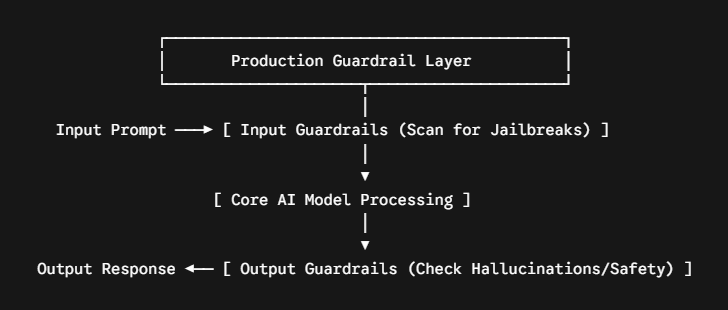
- Input Guardrails: Intercept user inputs before they reach the core LLM, scanning for toxic content, prompt injections, or unauthorized topics.
- Output Guardrails: Analyze generated model responses in real-time, blocking outputs that contain ungrounded hallucinations, PII leaks, or unsafe material before they render on the user’s screen.

No Comments