

16 Sep Intellectual Property, Copyright & Web Scraping
The rise of Generative AI has raised a critical ethical and legal issue about the conflict between AI developers and content creators. To build modern Large Language Models (LLMs), text-to-image tools, and code assistants, AI companies need to scrape billions of text files, artworks, images, and codebase repositories from the deep and surface web.
This lesson explores the ethical boundaries, legal battles, and emerging standards surrounding Intellectual Property (IP), copyright law, and data scraping in the AI ecosystem.
1. Web Scraping & The Data Mining Dilemma
Web scraping involves automated bots collecting massive datasets from websites, digital libraries, and social platforms to serve as AI training data.
Ethical & Operational Concerns
- Consent & Opt-Outs: Content creators traditionally uploaded work online for public viewing, not for commercial AI models to ingest and replicate.
- Robots.txt & Terms of Service (ToS): Many platforms explicitly prohibit web scraping in their Terms of Service. AI scrapers frequently bypass these rules or ignore robots.txt directives.
- Server Costs & Bandwidth Theft: Intensive data scraping places heavy loads on site servers, incurring infrastructure costs for website owners without providing traffic or revenue in return.
2. Copyright Infringement vs. Fair Use
At the heart of AI copyright disputes is whether training an AI on copyrighted material constitutes Copyright Infringement or is protected under Fair Use doctrines.
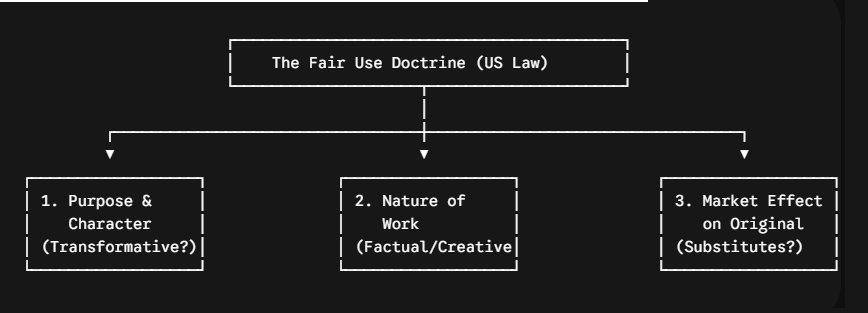
A. The “Transformative Use” Defense
AI developers argue that training models is transformative. The AI does not copy and paste original works; instead, it analyzes mathematical and statistical patterns to generate new, original outputs.
B. The Market Substitution Counter-Argument
Creators and publishers argue that AI outputs directly compete with and displace the human creators whose work was used to build the model—diluting the economic value of original art, journalism, and writing.
3. Copyright Ownership of AI-Generated Content
A central legal question is whether outputs generated entirely by artificial intelligence can be copyrighted:
| Jurisdiction | Copyright Eligibility Status | Core Principle |
| United States (USCO) | Not Eligible (if generated solely by AI) | Requires human authorship. Prompting an AI model is treated similarly to commissioning an artist—the prompter is not the legal author. |
| European Union (EU) | Not Eligible (generally) | Works must reflect the author’s own intellectual creation and express personal free/creative choices. |
| Hybrid Works | Partially Eligible | Human-authored text or custom manual edits layered over AI-generated assets can be copyrighted, but the underlying raw AI components cannot. |
4. Key Legal Precedents & High-Stakes Lawsuits
Several landmark legal cases are currently defining the boundaries of AI intellectual property:
- Artists vs. Image Generators: Class-action lawsuits filed by visual artists against platforms like Midjourney and Stability AI for scraping copyrighted art without consent or compensation to build text-to-image models.
- Publishers vs. AI Developers: Major lawsuits (such as The New York Times v. OpenAI/Microsoft) alleging that millions of copyrighted news articles were ingested without authorization, with models producing near-verbatim outputs.
- Code Repositories: Class-action suits alleging AI code assistants trained on open-source repositories violated open-source licenses (like GPL or MIT) by producing code without proper attribution or license compliance.
5. Solutions and Emerging IP Frameworks
To resolve the IP crisis, industry, legal, and open-source communities are developing technical and financial standards:
- Data Licensing Agreements: Commercial partnerships where AI companies pay content publishers and stock platforms (e.g., Reddit, Shutterstock, News Corp) for legal access to high-quality training data.
- C2PA & Provenance Standards: Standardized technical metadata embedded in media to track creation lineage, verify content authenticity, and flag AI-generated vs. human-created works.
- Glaze & Nightshade (Data Poisoning Tools): Technical defensive tools developed by researchers that apply subtle, invisible noise to digital artwork to prevent AI scrapers from correctly training on or mimicking an artist’s personal style.
- Robots.txt & AI Opt-Out Tags: Adoption of specific user-agent directives (e.g., GPTBot, CCBot) allowing site owners to block AI scraping crawlers while keeping their sites indexed for search engines.

No Comments