

16 Sep Black-Box AI & Explainable Methods (SHAP, LIME)
As machine learning models evolve from simple linear regression models to increasingly complex deep neural networks and ensembles of simpler models (e.g., XGBoost or Random Forests), their internal workings become progressively harder to decipher. While such models often exhibit state-of-the-art performance, they remain “black boxes,” whose internal mechanics are either deliberately obscured or too complex to be understood by humans.
Explainable AI (XAI) encompasses the set of processes and methods that allow human users to comprehend, trust, and audit the output of complex machine learning algorithms.
1. The Interpretability vs. Accuracy Trade-off
In traditional machine learning, model choice often involves a direct trade-off between predictive power and human interpretability:
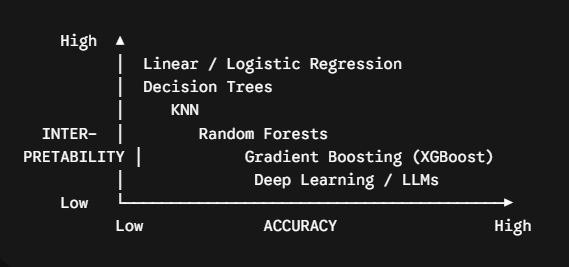
- Interpretable-by-Design (White-Box Models): Linear models, decision trees, and rule-based systems. You can directly read the mathematical weights or tree branches to understand how decisions are reached.
- Complex/Black-Box Models: Deep Neural Networks, Transformers, and Ensembles. They contain millions or billions of parameters, making direct manual interpretation virtually impossible.
2. Types of Explanations in XAI
Explainability techniques generally fall into distinct operational categories:
| Dimension | Option A | Option B |
| Scope | Global Interpretability: Explaining how the model works overall across the entire dataset (which features matter most generally). | Local Interpretability: Explaining why the model made a specific decision for a single individual or data point. |
| Model Specificity | Model-Specific: Explanations tied to internal architecture mechanics (e.g., attention maps in Transformers or feature map activations in CNNs). | Model-Agnostic: Post-hoc tools that evaluate inputs and outputs without needing access to the model’s internal source code or architecture. |
3. LIME (Local Interpretable Model-agnostic Explanations)
Proposed by Ribeiro et al. in 2016, LIME is a post-hoc, local, model-agnostic technique designed to explain individual predictions.
How LIME Works
LIME assumes that while a global black-box decision boundary might be extremely complex, it can be approximated locally with a simpler model (like a linear model) around a specific data point.
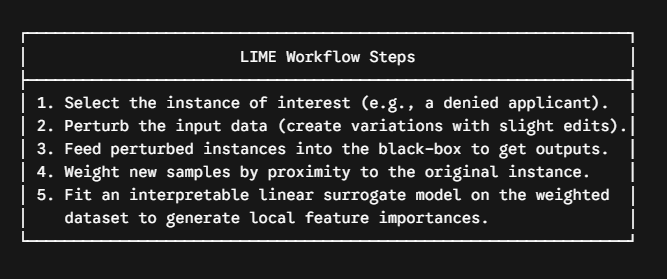
- Strengths: Fast, intuitive, works across structured data, text, and images.
- Weaknesses: Instability (runs can produce slightly different explanations due to random sampling); relies heavily on selecting appropriate perturbation distances.
4. SHAP (SHapley Additive exPlanations)
Proposed by Lundberg and Lee in 2017, SHAP grounds model explainability in Cooperative Game Theory using Shapley values (originally developed by Nobel laureate Lloyd Shapley).
How SHAP Works
In game theory, Shapley values determine how to fairly distribute a total payout among players based on their marginal contributions to a team effort.
- The Analogy:
- Players = Input features (e.g., Age, Income, Debt Ratio).
- Payout = The difference between the model’s actual prediction and the average dataset prediction ().
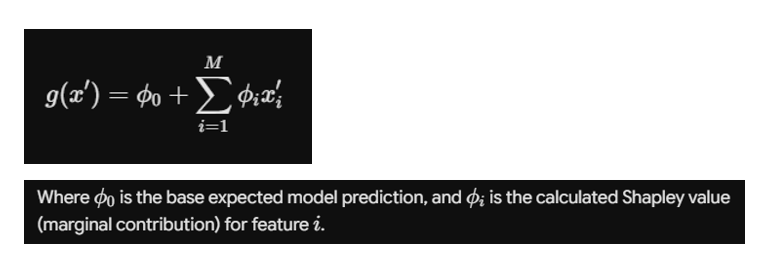
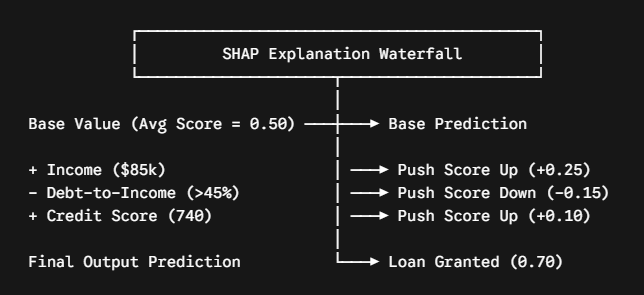
- Strengths: Mathematically sound, consistent, provides both local and global interpretability.
- Weaknesses: Computationally intensive for large datasets or deep neural nets (though optimized variants like TreeSHAP and DeepSHAP accelerate compute time).
5. Comparison: LIME vs. SHAP
| Feature | LIME | SHAP |
| Mathematical Basis | Local linear surrogate models | Game theory (Shapley Values) |
| Scope | Local only | Local and Global |
| Computation Time | Generally fast | Slow (exact); faster with approximations |
| Theoretical Consistency | Low (susceptible to sampling noise) | High (guarantees properties like Efficiency and Symmetry) |
| Best Use Case | Quick local debugging and text/image classification | High-stakes tabular decisions requiring rigorous compliance audits |
6. The Ethical Implication of Explainability
Explainability is not just a technical feature; it is a fundamental requirement in regulatory compliance and human rights:
- The Right to Explanation: Frameworks like the EU GDPR mandate that individuals subjected to automated decision-making (e.g., credit rejection, automated hiring, or parole decisions) have a right to meaningful information about the logic involved.
- Debugging & Auditing: Helps machine learning engineers spot shortcut learning or spurious correlations (e.g., a medical classifier identifying skin cancer based on a ruler printed in the photo rather than lesion pathology).
- Building Human Trust: Domain experts (like physicians, judges, and loan officers) require actionable explanations before acting on AI recommendations in high-stakes environments.

No Comments