

16 Sep Privacy, Facial Recognition & Mass Surveillance
The development and improvement of artificial intelligence and computer science technologies, such as computer vision, biometrics, and predictive analytics, now dominate many areas of human activity. The use of new technologies for surveillance has become an issue of civil liberties, as well as a matter of ethics.
This lesson explores how modern AI systems process personal data, the mechanics of automated facial recognition, and the societal implications of mass surveillance.
1. AI Data Harvesting & The Erosion of Privacy
Traditional privacy models rely on explicit consent, clear data boundaries, and user awareness. Modern AI architectures, however, thrive on big data harvesting; often collecting personal information without an individual’s knowledge or explicit consent.

- Data Aggregation & Re-Identification: AI models can ingest disparate, anonymized datasets (location logs, browsing history, transaction records) and cross-reference them to re-identify individuals with high statistical certainty.
- Inferred Sensitive Attributes: Machine learning algorithms can accurately infer sensitive unstated traits—such as political alignment, health conditions, sexual orientation, or emotional state—simply by analyzing micro-behaviors online or in public spaces.
2. Facial Recognition Technology (FRT)
Facial recognition converts facial images into digital mathematical representations (faceprints) to identify or verify individuals.
Operational Modes
| Mode | Function | Operational Mechanics | Ethical Risk Level |
| Verification (1:1 Matching) | Confirms whether a person is who they claim to be | Compares a live face against a single stored identity template (e.g., unlocking a smartphone). | Low to Moderate: Usually voluntary and executed locally on personal devices. |
| Identification (1:N Matching) | Determines a person’s identity out of a large crowd or database | Compares a target face against thousands or millions of stored faces (e.g., Clearview AI or law enforcement databases). | High: Frequently conducted without individual knowledge, consent, or opt-out capabilities. |
Technical Risks in Biometric Audits
- Demographic Disparities: Multiple NIST (National Institute of Standards and Technology) studies demonstrate that commercial facial recognition systems display higher false-positive rates for women and racial minorities—leading to wrongful arrests and systemic discrimination.
- Immutability of Biometrics: Unlike passwords or credit card numbers, biometric data cannot be changed if compromised in a data breach.
3. Mass Surveillance & Predictive Policing
When facial recognition is combined with widespread closed-circuit television (CCTV) networks, drone tracking, and machine learning, public spaces transition into continuous monitoring environments.
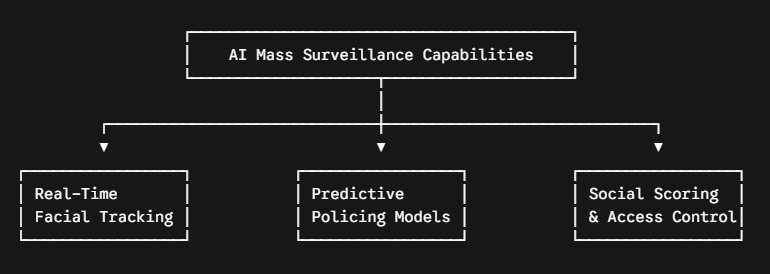
A. Real-Time Tracking & Chilling Effect
Continuous automated monitoring in public spaces creates a chilling effect on democratic rights. When citizens know they are continuously tracked via AI cameras, their freedom of assembly, political protest, and free speech are suppressed due to fear of retaliation.
B. Predictive Policing Algorithms
Predictive policing tools evaluate historical crime data to forecast where crimes will occur (location-based) or who is likely to commit a crime (person-based).
- Feedback Loops: Because historical policing data reflects past systemic bias and over-policing in specific neighborhoods, AI models disproportionately send officers back to those same communities, reinforcing biased patterns.
C. Social Credit and Behavioral Control
State-level surveillance networks use AI to aggregate biometric monitoring, financial records, and social behaviors into centralized scoring systems—restricting public transit access, employment, or travel for citizens deemed unfavorable.
4. Privacy-Preserving AI & Technical Countermeasures
To combat privacy violations while maintaining AI performance, computer scientists use specialized privacy-preserving techniques:
- Differential Privacy: Adding controlled mathematical noise to datasets so that machine learning models learn general population trends without revealing whether any specific individual’s data was included.
- Federated Learning: Training AI models decentrally across millions of edge devices (like smartphones) without centralizing raw user data to external servers.
- Adversarial Clothing & Anti-Surveillance Wearables: Designing clothing patterns, glasses, or LED patches that disrupt facial detection algorithms by introducing visual noise.
5. Global Regulatory Responses
Governments worldwide are establishing legal boundaries around AI-driven biometrics:
- EU AI Act: Categorizes real-time remote biometric identification in publicly accessible spaces for law enforcement as a prohibited risk (with strict, narrow exceptions like terror threats).
- Local FRT Bans: Cities and regions globally have enacted complete moratoria on municipal police use of facial recognition technology.
- GDPR (General Data Protection Regulation): Imposes strict limitations on biometric data processing, requiring explicit user consent and granting individuals the “Right to be Forgotten.”

No Comments