

16 Sep Global AI Regulations: EU AI Act & NIST Framework
As artificial intelligence enters critical infrastructure, finance, healthcare, and hiring, self-regulation and voluntary ethical guidelines are beginning to be replaced by official legal frameworks and standards.
To understand compliance, one must first understand the difference between the world’s two most influential frameworks: the EU AI Act (a binding, risk-based regulatory framework) and the U.S. NIST AI Risk Management Framework (RMF 1.0) (a voluntary, process-driven engineering standard).
1. The EU AI Act: Risk-Based Legal Regulation
Enacted by the European Parliament, the EU AI Act is the world’s first comprehensive, legally binding horizontal AI law. It enforces compliance based on a strict 4-tiered risk hierarchy.
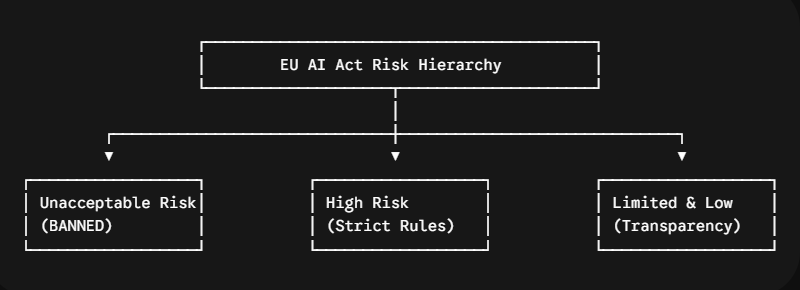
The 4 Risk Tiers
| Risk Tier | Criteria & Examples | Legal Requirement / Enforcement |
| 1. Unacceptable Risk | Threatens public safety or civil rights (e.g., social scoring by governments, biometric categorization of protected traits, emotion recognition in workplaces, untargeted scraping of facial images). | Banned entirely. Violations face maximum fines of up to €35 Million or 7% of global annual turnover (whichever is higher). |
| 2. High Risk | Deployed in critical domains (e.g., medical devices, critical infrastructure, credit scoring, hiring algorithms, law enforcement, education access). | Strict Compliance Mandatory: Must pass conformity assessments, maintain technical documentation, enforce human oversight, log system activity, and receive CE marking before deployment. |
| 3. General-Purpose AI (GPAI) | Foundation models capable of performing a wide range of distinct tasks (e.g., LLMs like GPT-4, Claude, Llama). | Must provide technical documentation, comply with copyright law, publish training data summaries, and adhere to additional systemic risk evaluation protocols. |
| 4. Limited & Minimal Risk | Low-risk systems (e.g., chatbots, spam filters, AI-generated synthetic media, video games). | Transparency Only: Users must be informed they are interacting with an AI system, and synthetic media must be clearly labeled/watermarked. |
2. NIST AI Risk Management Framework (AI RMF 1.0)
Published by the U.S. National Institute of Standards and Technology, the NIST AI RMF 1.0 is a flexible, voluntary framework designed to help organizations integrate trust and safety into the AI development lifecycle.
Rather than imposing bans, NIST establishes 4 Core Functions that form a continuous cycle for managing AI risks:
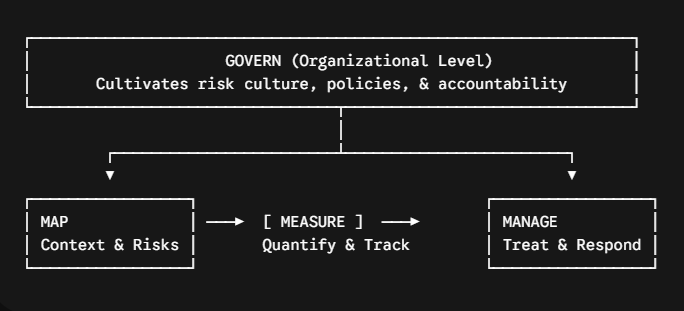
The 4 Core Functions
- GOVERN: Establishes organizational policies, risk appetite, executive accountability, and oversight structures. Spans the entire enterprise.
- MAP: Frames the specific operational context for an individual AI model. Identifies intended use cases, potential harms, and business constraints before development.
- MEASURE: Applies quantitative and qualitative metrics to evaluate model performance, bias, safety, and explainability across data slices.
- MANAGE: Allocates resources to mitigate identified risks, implement safeguards, and establish incident response plans for production systems.
3. Comparison: EU AI Act vs. NIST AI RMF
While both frameworks aim to increase trust and decrease algorithmic harm, their legal scope and operational philosophies differ significantly:
| Dimension | EU AI Act | U.S. NIST AI RMF 1.0 |
| Legal Nature | Hard law (Legally binding statute across the EU) | Voluntary guidance (Soft law / Industry standard) |
| Primary Approach | Product Safety & Rights-Based: Categorizes systems by application domain and potential harm. | Process-Oriented & Systemic: Provides actionable management steps tailored to an organization’s internal processes. |
| Geographic Scope | Extraterritorial (Applies to any company worldwide offering AI systems to users within the EU). | Primarily U.S.-focused (widely adopted globally by private enterprise as a best-practice benchmark). |
| Penalties | Up to €35M or 7% of global revenue for severe non-compliance. | None (voluntary framework; though often referenced in federal procurement and civil litigation). |
| Core Artifacts | Conformity Assessments, CE Marking, EU Database Registration, Risk Management Systems. | Risk Inventories, MAP/MEASURE Profiles, System Impact Assessments. |
4. Other Key Global AI Laws and Standards
Beyond the EU and U.S. NIST, several major international legal standards shape global compliance:
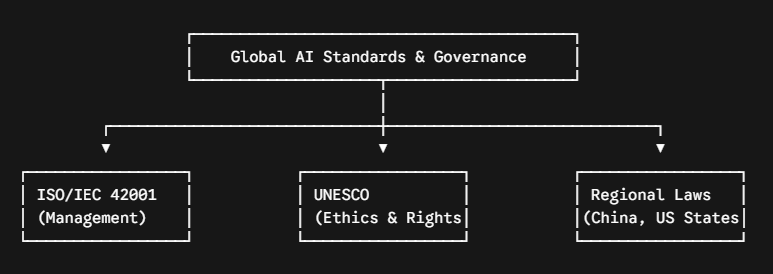
- ISO/IEC 42001: The international certifiable standard for an Artificial Intelligence Management System (AIMS). Provides audit-ready requirements for corporate AI governance.
- China AI Regulations: Specific, targeted measures governing generative AI services, algorithm recommendation engines, and deep synthesis (deepfakes), mandating security assessments, real-name registration, and algorithmic filings with the Cyberspace Administration of China (CAC).
- U.S. State-Level AI Laws: Individual legislation (such as the California AI Transparency Act and Colorado AI Act) regulating high-risk algorithmic discrimination, deepfake labeling, and synthetic media provenance.
- UNESCO Recommendations on the Ethics of AI: The first global consensus framework adopted by 193 member states, emphasizing human rights protection, gender equality, and environmental safeguards.
5. Enterprise AI Compliance & Audit Readiness
Organizations deploying AI models globally must establish a unified compliance pipeline to adhere to overlapping legal standards:
- Maintain a Central AI Inventory: Maintain an updated registry tracking every internal and third-party AI system, its data dependencies, intended business context, and operational deployment status.
- Perform Risk Classification: Classify each system against the EU AI Act risk tiers and identify high-risk use cases requiring third-party audits.
- Embed Governance into MLOps: Integrate automated testing layers into machine learning pipelines (CI/CD) to continuous-log model provenance, bias metrics, and drift evaluations.
- Establish Human-in-the-Loop Safeguards: Ensure high-risk decisions can be reviewed, overridden, or halted by trained human operators.

No Comments