

08 Oct Standard vs Custom MCP Servers
MCP Servers can be pre-built or created from scratch. Let us understand the standard as well as custom MCP servers.
Standard MCP Servers
Pre-built, Community-Maintained:
{
  "type": "standard",
  "examples": [
    "firecrawl-mcp",
    "postgres-mcp",
    "github-mcp",
    "filesystem-mcp"
  ],
  "characteristics": [
    "Well-documented",
    "Community supported",
    "Regular updates",
    "Battle-tested"
  ]
}
Advantages:
- Quick setup
- Reliable
- Community support
- Regular updates
Disadvantages:
- Limited customization
- May not fit specific needs
- Dependency on maintainers
Custom MCP Servers
Built for Specific Needs:
{
  "type": "custom",
  "examples": [
    "company-internal-api-mcp",
    "proprietary-database-mcp",
    "specialized-tool-mcp"
  ],
  "characteristics": [
    "Tailored to exact requirements",
    "Full control over features",
    "Proprietary logic",
    "Specific integrations"
  ]
}
When to Build Custom:
- Unique business requirements
- Proprietary data sources
- Specialized processing logic
- Performance optimization needs
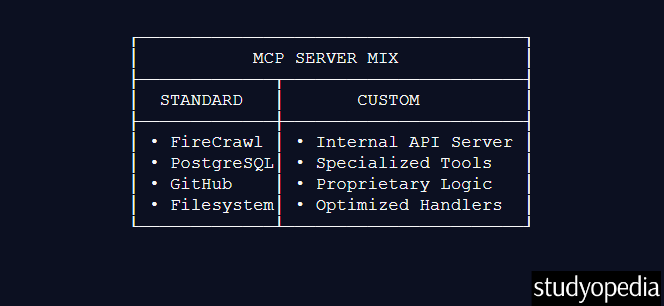
Standard MCP Server Components
These are widely used, off-the-shelf technologies that provide foundational infrastructure. They’re reliable, well-documented, and typically open-source or third-party services.
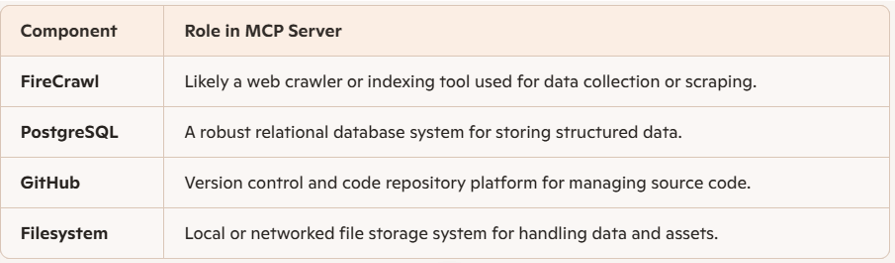
These components are plug-and-play, meaning they can be integrated with minimal customization and are often used across many tech stacks.
Custom MCP Server Components
These are tailored, in-house solutions designed to meet the specific needs of the MCP architecture. They offer flexibility, performance optimization, and proprietary capabilities.
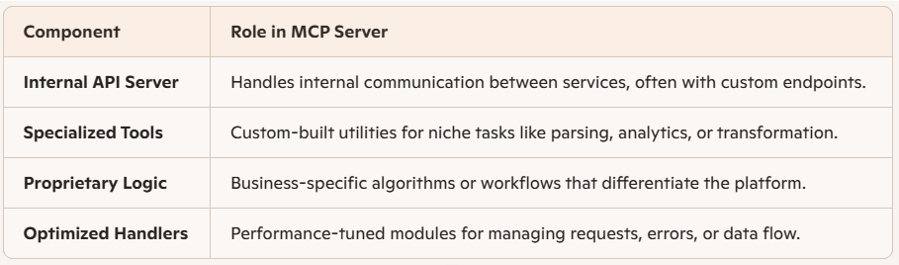
These components are custom-coded, giving you control over behavior, scalability, and integration with other systems.
If you liked the tutorial, spread the word and share the link and our website Studyopedia with others.
For Videos, Join Our YouTube Channel: Join Now
Read More:
- What is Deep Learning
- Feedforward Neural Networks (FNN)
- Convolutional Neural Network (CNN)
- Recurrent Neural Networks (RNN)
- Long short-term memory (LSTM)
- Generative Adversarial Networks (GANs)

No Comments