

08 Oct What is MCP Architecture
MCP follows a client-server architecture where AI applications (clients) communicate with specialized data services (servers) through a standardized protocol.
Here is a diagram explaining the same:
The diagram provided accurately represents the core architecture of an MCP (Model Context Protocol) ecosystem as described in authoritative references. The architecture generally consists of three main components: the AI Client, the MCP Protocol, and MCP Servers.
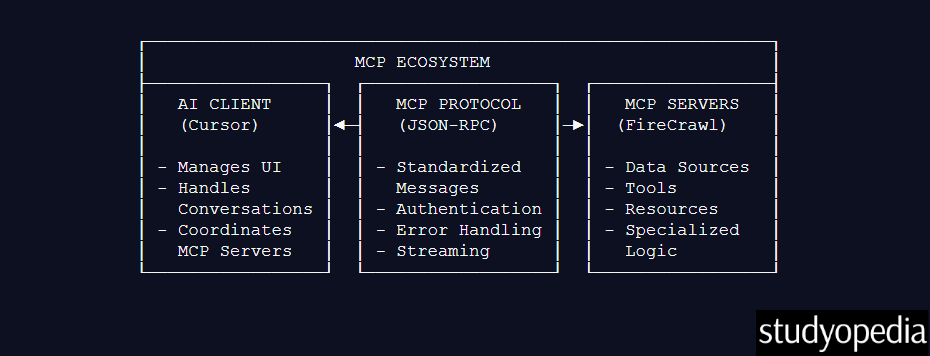
Let us understand them one by one:
AI Client
- Manages the user interface, handles conversations, and coordinates which MCP servers are invoked for tool/resource access.
- Acts as a bridge between end-users and the underlying AI or automation services.
- Responsible for session management and consent, ensuring security boundaries between servers.
MCP Protocol
- Implements structured, standardized communication (typically over JSON-RPC), including message formats, authentication, error handling, and streaming capabilities.
- Enables interoperability between clients and servers while enforcing security and access controls.
MCP Servers
- Provide data sources, specialized tools, or custom logic on demand.
- Expose capabilities like web scraping (e.g., FireCrawl), search, extraction, and other functions via protocol primitives.
- Are isolated processes—may be remote or local—and are only given access to exactly the data required for a specific request, maintaining strict context boundaries.
If you liked the tutorial, spread the word and share the link and our website Studyopedia with others.
For Videos, Join Our YouTube Channel: Join Now
Read More:
- What is Deep Learning
- Feedforward Neural Networks (FNN)
- Convolutional Neural Network (CNN)
- Recurrent Neural Networks (RNN)
- Long short-term memory (LSTM)
- Generative Adversarial Networks (GANs)

No Comments