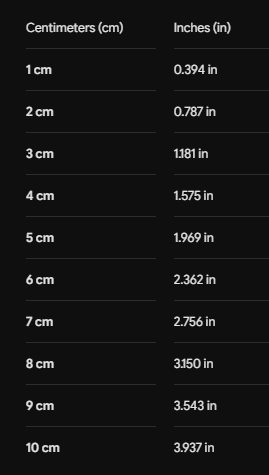

inches to cm converter
in
cm
m
Inches (in)
An inch (in) is a unit of length in the British Imperial and United States Customary systems of measurement. Since the signing of the International Yard and Pound Agreement in 1959, the inch has been precisely defined in terms of the metric system.
History
The word “inch” comes from the Latin uncia, meaning “one-twelfth part”. Historically, its definition varied. One traditional English definition established by King Edward II in 1324 declared that an inch was equal to “three grains of barley, dry and round, placed end-to-end lengthwise.” Other regions defined it by the width of a human thumb. To eliminate these inconsistencies, the international standard was locked to exactly $2.54\text{ cm}$ in 1959.
Common Uses
The inch is primarily used in the United States, Canada, and the United Kingdom. However, it still retains global standard status in several specific industries:
- Electronics: Screen sizes for televisions, smartphones, tablets, and computer monitors are measured diagonally in inches.
- Automotive & Mechanical: Wheel/rim diameters, tire widths, and pipe threads are frequently sized in inches.
- Aviation & Engineering: Altitude is measured in feet, and many legacy manufacturing tools utilize standard imperial fractions of an inch.
Centimeters (cm)
A centimeter (cm) is a unit of length in the International System of Units (SI), commonly known as the metric system. It is defined as one-hundredth of a meter, which is the base unit of length in the SI system.
History
The metric system was born out of the French Revolution in the late 18th century, designed to replace a chaotic system of regional weights and measures with a single, rational standard based on decimal division. In 1799, the meter was officially defined as one ten-millionth of the distance from the equator to the North Pole along the Paris meridian.
Common Uses
The centimeter is used globally for everyday measurements where the meter is too large but the millimeter is too small. Common uses include:
- Measuring body height, clothing sizes, and waistlines.
- Specifying dimensions of household objects, electronic screens, and furniture.
- Educational tools (school rulers are typically marked in centimeters and millimeters).
- Scientific and medical records (e.g., measuring the size of an incision or a surgical site).